
GrowthStack Advisory / AI sales tool stack / HubSpot vs Salesforce
HubSpot vs Salesforce: the CRM your team will actually use
The short answer
HubSpot is the safer CRM for most early and growth-stage B2B teams because the whole team will actually use it; Salesforce is the better fit once you have real complexity and a proper implementer. Shobhit Gupta has implemented and optimised both, including the CRM rebuild for Landmark Group's SaaS division. The deciding factor is rarely features, it is adoption, and the CRM people update beats the one with more options.
- HubSpot - easier adoption, marketing and sales in one environment. Best for early and growth-stage teams.
- Salesforce - more power and customisation, worth it with real complexity and a proper implementer.
- The failure mode is the same for both, a CRM so over-configured that reps stop updating it.
- Choose for adoption first. The most powerful CRM is the one that stays current.
For most early and growth-stage B2B teams, HubSpot is the safer CRM, because the whole team will actually use it. Salesforce is the better fit once you have real complexity and someone to implement it well.

HubSpot vs Salesforce: which is right for you?
The two are not really competing on capability, they are competing on who your team is. HubSpot is opinionated and easy to adopt. Salesforce is deep and configurable, and it needs someone who knows it.
| HubSpot | Salesforce | |
|---|---|---|
| Best fit | Early and growth-stage teams | Larger orgs with real complexity |
| Adoption | Easier, reps keep it updated | Harder, needs discipline and an admin |
| Marketing and sales | One environment, out of the box | Possible, with more setup |
| Customisation | Enough for most, opinionated | Deep, almost unlimited |
| Implementation | Light, fast to stand up | Heavy, needs a real implementer |
| Reporting | Good, straightforward | Deeper, more configurable |
| Failure mode | Outgrown at high complexity | Over-configured until nobody updates it |
| Who should run it | Your team | An admin who knows Salesforce |
When should you choose HubSpot over Salesforce?
HubSpot is the right call for an early or growth-stage company that wants the team to actually use the CRM. Adoption is easier, reps keep it updated, and marketing and sales end up in the same environment instead of arguing across two systems.
For most companies at this stage, that is the whole decision. A CRM only helps if it is current, and the one people update wins over the one with more features. Get targeting and qualification right first, then keep the CRM simple enough that reps do not resent it.
When is Salesforce the right CRM?
Salesforce earns its place when there is real complexity: a larger sales org, custom processes, several teams, deeper reporting and DevOps needs. If you have outgrown what an opinionated tool allows, Salesforce gives you room that HubSpot does not.
The condition is that you have someone to implement it well. Salesforce rewards a proper admin and punishes a team that sets it up on the side. If nobody owns the configuration, the power turns into a liability.
Which CRM has Shobhit implemented?
Both. Salesforce and HubSpot have each been implemented and optimised across the SDR and revenue operations functions Shobhit Gupta ran at Locus, GoComet and Landmark Group. At Landmark's SaaS division the CRM rebuild sat alongside the ICP, persona and sequence work that supported $500K ARR in the first quarter.
The failure mode was identical in every case, and it had nothing to do with which vendor was chosen: a CRM configured with more required fields than a rep will fill in mid-call stops being updated, and once it is stale every report built on it is fiction.
What makes a CRM implementation fail?
The failure mode is the same for both, and it is not about the brand. I have seen CRMs with so many fields, stages and workflows that reps stop updating them, then management says the data isn't accurate. Of course it isn't. You built a CRM the sales team hates using.
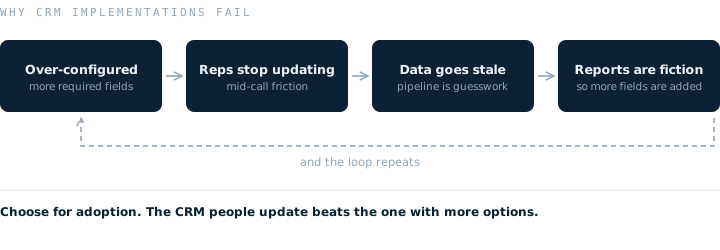
Salesforce just makes this easier to do, because it lets you configure more. A badly built Salesforce is worse than no CRM, because it looks like a system while quietly holding stale data. Start with the fields you will actually use, and add complexity only when a real need forces it.
References
Frequently asked questions
Is HubSpot or Salesforce better for a startup?+
HubSpot in most cases. Adoption is easier and marketing and sales share one environment, which matters more at that stage than deep customisation. Move to Salesforce when real complexity forces it.
When should you move from HubSpot to Salesforce?+
When you have outgrown what HubSpot allows: a larger org, custom processes across several teams, and reporting or DevOps needs it cannot meet - and you have an admin to implement Salesforce properly. Moving before that trades an easy, current CRM for a harder one.
Why do Salesforce implementations fail?+
Usually over-configuration. Too many fields, stages and workflows make the CRM painful to update, so reps stop, and then the data is unreliable. The tool did not fail, the setup did.
Can you run marketing and sales in both?+
Yes, but HubSpot does it in one environment with less setup. Salesforce can too, with more configuration and often extra tools. For a team that wants marketing and sales aligned quickly, HubSpot is the shorter path.
How do HubSpot and Salesforce compare on price?+
Both publish per seat pricing by edition, and both look cheap next to what implementation actually costs. HubSpot has a free CRM tier and gets more expensive as you add hubs. Salesforce starts paid and gets more expensive as you add configuration and admin time. Compare the total of licence plus the person who will own the system, because the second number is usually the one that decides whether it gets adopted.
Related reading
- The full B2B sales tool stack, by team size
- Apollo vs ZoomInfo: startup speed vs enterprise data
- Outreach vs Salesloft: for teams mature enough to need one
- HubSpot and Salesforce setup, as an engagement
- The HubSpot Prospecting Agent: what it does, and what it costs
- Salesforce in Claude: the CRM plugin, and what it inherits
- GTM analytics and pipeline reporting
- ICP and messaging, the layer before the CRM
Not sure which CRM your team will actually use?
We will look at your stage, your process and who owns the system, then tell you which CRM fits and how to set it up so reps keep it current.
Book a CallWritten with AI assistance from Shobhit Gupta’s notes and client work, then reviewed and edited by Shobhit Gupta on .