
GrowthStack Advisory / Resources / Meeting No-Shows
Why booked meetings do not happen, and how to cut the no-show rate
The short answer
A high no-show rate is almost never a sign of weak demand. It is a process fault, and it concentrates in four places: how the meeting was qualified before it was booked, how many days sit between booking and the meeting, whether the invitation gives the buyer a reason to attend, and whether anything happens in between. On named client work at ConvertCart, a conversion rate optimisation company serving eCommerce brands in the US and UK, meeting no-show rates fell from 44% to 15% through those changes rather than through more outreach. The single largest lever is usually the gap between booking and meeting, because intent decays faster than most teams assume.
- Not a demand problem. The buyer already said yes once
- The booking-to-meeting gap is usually the largest single lever
- A calendar invite is a message, and most are blank
- 44% to 15% at ConvertCart came from process, not volume

Founder, GrowthStack Advisory. Ran sales development at Locus, GoComet and Landmark’s Logistiq division, and has since delivered for Easyship, ConvertCart and WorkStore. LinkedIn.
· 7 min read
What a no-show actually costs
The obvious cost is the half hour. The real cost is the pipeline arithmetic underneath it. Show rate is one of four things the inbound lead conversion engagement fixes.
A team holding 44 meetings out of every 100 booked is running at less than half the capacity its activity implies, and every forecast built on meetings booked rather than meetings held overstates pipeline by the same margin. The reporting looks healthy while the revenue does not, which is the same pattern as stage inflation described in how to audit a sales pipeline.
There is a second cost that is easier to miss. Reps who are repeatedly stood up start over-booking to protect their number, which means accepting meetings they would otherwise have disqualified, which raises the no-show rate further. It compounds quietly and it is usually well advanced before anyone names it.
The four causes, in order of size
A no-show is a buyer who already said yes once and then did not turn up. That narrows the explanation considerably, because the interest was real at the moment it was expressed.
- The meeting was never qualified. A prospect who agreed to a call to end the conversation politely will not attend it. Booking without establishing that a problem exists produces a calendar entry rather than an opportunity.
- Too many days in between. The most common and the most fixable. Intent decays, priorities move, and the person who agreed on Monday has a different week by the following Thursday.
- The invitation says nothing. A blank calendar entry titled Intro Call gives a busy person no reason to defend the slot when something else lands on it.
- Nothing happened in between. Silence between booking and meeting reads as low priority from the seller too, which makes it easier to treat as optional.
Note what is absent from that list: the quality of the outreach that produced the meeting. That determines whether a meeting gets booked at all. It has very little to do with whether a booked meeting happens.
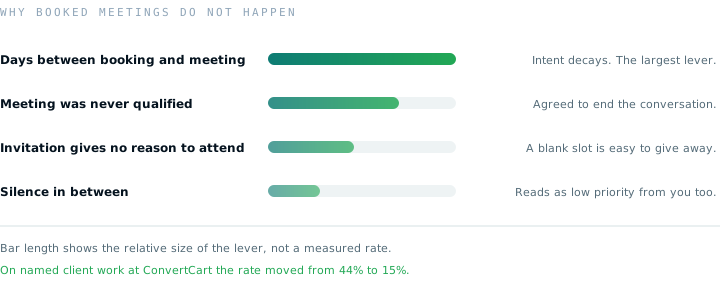
The gap between booking and meeting
If only one thing is changed, change this one.
Every additional day between agreement and meeting is a day in which something else can take the slot. A call booked for the next working day holds far better than the same call booked ten days out, and the difference is large enough that it usually swamps every other intervention on this page.
The practical implication is about availability rather than persuasion. Where a rep offers times a week ahead because the coming days are full, the constraint is capacity, and the fix is fewer meetings booked and more of them held. A calendar link that only surfaces slots eight days out is quietly manufacturing no-shows.
Where a long gap is unavoidable, such as a buyer who genuinely cannot meet sooner, the gap has to be actively managed rather than waited out, which is what the reminder sequence below is for.
The invitation nobody writes
A calendar invitation is the last message a buyer sees before the meeting, and it is usually the only one nobody writes.
Three things belong in it. What will be covered, in one sentence and in the buyer’s language rather than the seller’s. How long it will take, stated precisely, because a person protecting a 25 minute slot behaves differently from one protecting an open-ended call. And who will attend from both sides, which quietly prompts the buyer to bring the colleague who actually decides.
Adding a single line naming the problem the buyer described in their own words is the highest return sentence available here, because it converts a generic obligation into a specific one. The same principle governs the outreach that produced the meeting, covered in how to structure a B2B outbound sequence.
A reminder sequence that works
Reminders fail when they are automated notifications and work when they are contact. The distinction matters more than the number of them.
- On booking, immediately. A short human message confirming the slot and restating the one thing the meeting is about. Automated calendar confirmations do not count; they arrive from a system and are read as one.
- The day before. Confirmation plus something small and useful, so the message has a reason to exist beyond reminding. A relevant example or a single question to think about.
- The morning of, for longer gaps. One line. Still on for 3pm. Easy to answer, and a reply is itself a signal that the meeting will happen.
A reply to any of the three is the most reliable predictor available. Silence across all three on a meeting booked two weeks out is close to a decision, and it is better to find that out on the morning than at the hour.
Channel matters at the margin. A reminder that reaches someone where they already replied, whether that is email or LinkedIn, outperforms one sent through whichever channel the tooling defaults to. Adding LinkedIn as a second channel was part of the same ConvertCart engagement.
What to do when they do not show
Two rules, both of which are about restraint.
Wait the full window before giving up on the call, then send one short message the same day offering to rebook, with no reference to the absence. Most no-shows are not deliberate, and a message that makes someone feel caught converts an oversight into an avoidance.
Then rebook once. A prospect who misses a second scheduled meeting has told you something factual about priority, and continuing to chase them is a decision to spend the quarter on an account that is not ready. That is a disqualification, which is a normal outcome and should be recorded as one rather than left open, for the reasons set out in choosing a qualification framework.
Measuring it
Report meetings held rather than meetings booked, and report the ratio between them as its own number.
Split it two ways. By rep, because a no-show rate concentrated in one person is usually a qualification habit rather than bad luck, and by source, because meetings that come from a form fill behave differently from meetings a rep worked for over several weeks.
Where the rate is concentrated in a rep rather than spread across the team, the investigation is the five lever diagnostic. Where compensation pays on meetings booked, expect the rate to be worse, because the plan is paying for the booking and nothing is paying for the attendance.
Related reading
A related but separate problem is the inbound lead who never answers in the first place, which is speed to lead. Once meetings are being held, what happens to them next is MQL to SQL conversion. Booking and confirming meetings around conferences is covered in event prospecting.
The ConvertCart and WorkStore engagements are described on B2B lead generation for e-commerce and D2C.
Frequently asked questions
What is a normal sales meeting no-show rate?+
There is no reliable public benchmark, and the useful comparison is your own trend rather than an industry figure. What is measurable is the size of the movement available: on named client work at ConvertCart, a conversion rate optimisation company serving eCommerce brands in the US and UK, no-show rates fell from 44% to 15% through process changes rather than more outreach. A rate that high is common and is almost always fixable.
Why do prospects not show up to booked meetings?+
Four causes, in order of size: the meeting was never really qualified and the prospect agreed to end the conversation politely, too many days sit between booking and the meeting, the calendar invitation gives no reason to defend the slot, and nothing happened in between. Notice that the quality of the original outreach is not on the list. That decides whether a meeting is booked, not whether it happens.
How far in advance should sales meetings be booked?+
As close to the agreement as possible. Every additional day is a day in which something else can take the slot, and a call booked for the next working day holds far better than the same call booked ten days out. Where a rep offers times a week ahead because the coming days are full, the real constraint is capacity, and a calendar link that only surfaces slots eight days out is quietly manufacturing no-shows.
Do reminder emails reduce no-shows?+
Automated notifications do very little. Contact does. A short human message on booking, a message the day before carrying something useful rather than only a reminder, and one line on the morning for longer gaps. A reply to any of the three is the most reliable predictor available, and silence across all three on a meeting booked two weeks out is close to a decision.
Should you rebook a prospect who did not show?+
Once. Send one short message the same day offering to rebook, with no reference to the absence, because most no-shows are not deliberate and a message that makes someone feel caught turns an oversight into avoidance. A prospect who misses a second scheduled meeting has told you something factual about priority, and that should be recorded as a disqualification rather than left open.
Leads arriving, pipeline not following
Thirty minutes on whether it is a targeting, qualification or follow up problem.
Book 30 minutesWritten with AI assistance from Shobhit Gupta’s notes and client work, then reviewed and edited by Shobhit Gupta on .