
GrowthStack Advisory / Sales Qualification
Sales qualification frameworks: BANT vs MEDDIC vs your own
The short answer
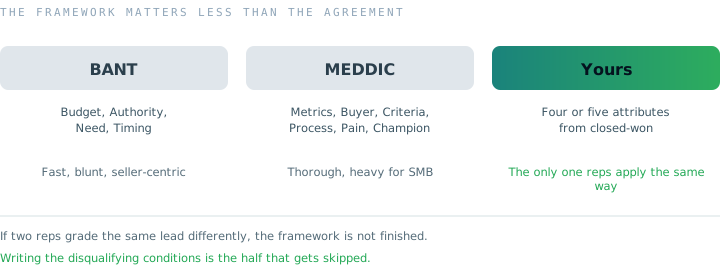
BANT (budget, authority, need, timeline) is a quick screen for first contact. MEDDIC (metrics, economic buyer, decision criteria, decision process, identify pain, champion) is a deeper check for complex opportunities. Most B2B teams should use BANT at first touch and MEDDIC at the opportunity stage, then rewrite both as criteria specific to their own closed deals, because the framework matters less than whether two reps grade the same lead the same way. Test it by having two reps grade five recent calls independently: any disagreement means the criteria are not finished. Writing the standard down moved MQL to SQL conversion from 10% to 25% at Locus, with no added lead volume.
- Generic frameworks get interpreted differently by every rep, producing a forecast nobody trusts
- State the evidence required, not the concept
- Run the two rep exercise until grading agreement is near total
- Only then does MQL to SQL conversion become a real signal
BANT, MEDDIC, CHAMP. The framework you pick matters far less than whether two of your reps would grade the same lead the same way.

Founder, GrowthStack Advisory. 10+ years building SDR and GTM systems at Locus, GoComet, and Landmark Group. LinkedIn.
· 3 min read
What is a qualified lead?
A qualified lead is one that meets a written standard your team agreed in advance, evidenced by something the buyer said or did rather than by how the call felt. The standard usually covers a real problem the buyer has named, budget or a route to it, access to whoever signs, and a reason to act inside a defined window.
The distinction that matters day to day is between an MQL and an SQL. An MQL has shown interest, usually by filling in a form or engaging with content. An SQL has been spoken to and graded against your criteria. Most teams that believe they have a lead generation problem in fact have no written line between the two, which is why the handoff leaks and why the same lead gets graded differently by two reps in the same week.
BANT vs MEDDIC: which should you use?
BANT asks about Budget, Authority, Need and Timeline. It was designed at IBM for a simpler market and it is fast, which is its real advantage: a rep can run it inside a first call without derailing the conversation.
MEDDIC asks about Metrics, Economic buyer, Decision criteria, Decision process, Identify pain and Champion. It is built for complex deals with several stakeholders, and it is a deal inspection tool rather than a first-call script.
| BANT | MEDDIC | |
|---|---|---|
| Built for | Speed at first touch | Complex, multi-stakeholder deals |
| Used by | SDRs and inbound reps | AEs and sales leadership |
| Applied at | First call, within minutes | Opportunity review, over weeks |
| Fails when | Budget is unknown early, which is normal | Reps fill it in retrospectively to please a forecast |
| Answers | Is this worth a meeting? | Will this deal close, and what is missing? |
For most B2B teams this is not an either/or. BANT at first touch and MEDDIC at the opportunity stage is a reasonable default, because they answer different questions at different moments. What decides the outcome is not which acronym you adopt, it is whether the criteria underneath it are specific to your business.
That view comes from running BANT rather than reading about it. Shobhit Gupta was hired at Locus to do exactly this job: inbound enquiries were arriving for a logistics SaaS product with nobody to call them, and the brief was to qualify each one on BANT and hand the survivors to sales. For the first seven to eight months that was the whole role, call by call, including explaining the product and running demos where the enquiry warranted one.
Two things become obvious quickly when you apply BANT several times a day. The first is that Budget is close to useless at first touch, because on an inbound call the prospect usually does not know it yet, and pressing for a number produces either a guess or a defensive answer. The second is that Need is where the entire judgement actually sits, and BANT gives you no help with it. The letter is one word. Whether that word means a real operational problem or idle curiosity is the decision, and the framework is silent on how to tell.
Which is the argument of this page, arrived at the slow way. The acronym is a prompt sheet, not a standard. What made the difference later was writing down what Need meant for that specific business, in language two reps would grade identically.
Writing down what Need means for one specific business is the same exercise as defining the buyer in the first place, which is why qualification criteria and ICP work cannot be separated. That is covered in ICP, persona and messaging frameworks.
Why do qualification frameworks fail in practice?
Both frameworks fail the same way. They are generic by design, so a rep applies them from memory and grades on impression rather than evidence. Ask two reps to score the same call against BANT and you will often get two different answers, which means the pipeline number downstream is not measuring anything stable.
The structural problem is bigger than the acronym. A typical buying group for a complex B2B solution now runs to six to ten decision makers, each arriving with four or five independently gathered pieces of information (Gartner), and more than three quarters of buyers describe the process as very complex or difficult (Gartner). A four letter checklist applied to one contact cannot describe a group that size. That is not an argument against frameworks, it is an argument for writing down what evidence counts.
How do you write qualification criteria reps will apply?
Start from your last twenty closed deals rather than from the framework. For each one, write down what was true at the point the deal became real: what the buyer said, who was in the room, what triggered the search, and what they had already tried. Then look for what the won deals share and the lost ones do not.
Turn each of those into a criterion with an evidence test attached. Not "has budget" but "has named a budget owner or stated a range". Not "has need" but "has described a specific problem in their own words, with a consequence attached". A criterion a new hire could apply on their second day, without asking a manager, is finished. One that requires judgement is not.
Write the disqualifiers with the same care. Most teams list what a good lead looks like and never state what makes one unworkable, which is the half that actually saves rep time. This is the same discipline behind an ICP sales will actually use.
Test it with the two rep exercise
Take five recent calls. Have two reps grade each one independently against your written criteria, without discussing it. Then compare.
Disagreement on any lead means the criteria are not finished, and the gap is almost always in the same place: a word that means something different to each rep. "Engaged", "interested" and "a good fit" are the usual culprits. Rewrite the criterion until the disagreement disappears, then run the exercise again with five different calls.
This takes about an hour and it is the cheapest diagnostic in sales development. It also tells you something no dashboard will, which is whether your pipeline data has been produced by one standard or by however many reps you employ.
Then measure it
Once the standard is stable, report against it weekly by source and by rep. Two numbers matter: the proportion of leads that pass qualification, and the proportion of qualified leads that go on to close. The first tells you whether the criteria are set at the right height. The second tells you whether they are predicting anything real.
If qualification rates rise but closed revenue does not move, the criteria are too loose and you have renamed the problem rather than fixed it. If both move together, the standard is doing its job. That relationship is the whole point of the exercise, and it is covered in more depth in improving MQL to SQL conversion.
What happens when the criteria are written down?
At Locus, writing the qualification standard down and enforcing it at stage exit moved MQL to SQL conversion from 10% to 25%, and lead to closure from 5% to 11%. No framework was adopted wholesale. The criteria were specific to the deals that had actually closed. Whether your current criteria hold up is one of the first things a sales pipeline audit checks.
GrowthStack repeated the exercise twice. For Easyship, subscription conversions rose 20% within the first month. For WorkStore, paid media lead qualification moved from 5% to 30% in two months.
WorkStore is the clearest example of criteria written for one specific business rather than lifted from a framework. As the exclusive India partner for the Dyson Airblade series, it sells commercial hand dryers and air purifiers to facilities and procurement teams at hotels, hospitality chains, hospitals, commercial real estate and managed office operators. Inbound arrived from the website, from paid media and from referral partners, and the four criteria a rep applied on the call were budget, genuine need, timeline, and the number of units required.
That fourth criterion is the instructive one. Unit count does almost no work in a software deal and decides the opportunity in a hardware one, and it was the criterion that most often separated a real buyer from an enquiry. No published framework would have supplied it. It came from looking at which deals had actually closed, which is the whole argument of this page.
Leads were also pooled and segmented by state before any of this, because India is not one market for a product sold to facilities teams, and routing decided how fast a qualified lead reached someone who could sell it.
“I have worked with Shobhit closely as a regional lead at Locus and Global lead at GoComet. His strength is setting up processes, cadence, solving hard problems and always focussing on the numbers. He is never shy of doing the ground work with the team and coaching them on how things are done with example.”
Ayesha Zafar · Technology Sales, GTM Strategy · worked with Shobhit on the same team ·
References
Related reading
- Raising the rate at which sales accepts marketing leads
- Improving MQL to SQL conversion
- How to build a B2B ICP
- SDR coaching and playbooks
Where a framework is already written down and the numbers still do not move, the next step is a pipeline audit, which locates the stage the deals are actually leaving at.
Questions
Is BANT still relevant?+
BANT is a reasonable starting shape, but on its own it is too generic for consistent grading. Adapt it into evidence based criteria specific to your deals, then test that two reps grade identically.
What makes a lead sales qualified?+
A lead is sales qualified when it meets your written, evidence based criteria for fit, problem, authority, and timing. The definition must be specific enough that two reps reach the same verdict independently.
Tell us where the funnel leaks
We will tell you whether it is a targeting, execution, or qualification problem, and what it would take to fix.
Book a CallWritten with AI assistance from Shobhit Gupta’s notes and client work, then reviewed and edited by Shobhit Gupta on .