
GrowthStack Advisory / B2B ICP Framework
How to build a B2B ICP sales will actually use
The short answer
A useful B2B ICP starts from your last twenty wins and losses, states the disqualifying criteria as clearly as the ideal ones, tiers accounts by how likely they are to buy this quarter, and ends in a named account list rather than a document. Shobhit Gupta has built this from zero for NuVista AI and for Landmark Group's SaaS division. An ICP that does not produce a working list has not finished. The disqualifying criteria do most of the work. Company size below the point where budget exists, nobody who owns the problem, a competing tool bought in the last six months, a geography you cannot support. At Locus, where Shobhit Gupta led global sales development across the US, Europe, the Middle East and Asia, tightening who counted as a target is what moved MQL to SQL conversion from 10% to 25%.
- Start from closed won, not from ambition or firmographics alone
- Write disqualifiers first, they save more rep time than ideal criteria
- Tier accounts so research effort matches buying likelihood
- Finish with a list, not a document
Most ICP documents describe a company that does not exist and get ignored within a week. The useful version is shorter, has disqualifiers, and ends in a named account list.

Founder, GrowthStack Advisory. 10+ years building SDR and GTM systems at Locus, GoComet, and Landmark Group. LinkedIn.
· 3 min read
Why do most B2B ICP documents get ignored?
The typical ICP is a slide describing a 200 to 2,000 employee company in a broad vertical with a vague pain. Every rep reads it, nobody can act on it, and targeting quietly reverts to whoever answers the phone.
A working ICP does three things a slide does not: it names disqualifying criteria, it tiers accounts by how likely they are to buy this quarter, and it resolves into a specific list of companies with named contacts.
How do you build an ICP from closed won deals?
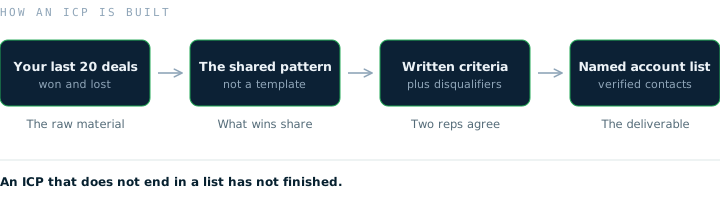
Pull your last 20 closed deals and your last 20 losses. Look for what the wins share that the losses do not: a trigger event, a technology already in place, a team structure, a regulatory deadline, a growth stage. Firmographics alone rarely separate them.
If you have too few deals to analyse, use the closest proxy: the accounts that engaged most seriously, even if they did not buy.
What are ICP disqualifying criteria?
Disqualifying criteria save more time than ideal criteria. Company size below a threshold where budget does not exist. No one holding the problem you solve. A competing tool bought within the last six months. Geographies you cannot support. Write these down and let reps remove accounts without asking permission.
Tier the list
- Tier 1 matches the profile and shows a trigger event now. Research deeply, personalise heavily.
- Tier 2 matches the profile without a trigger. Sequence with light personalisation.
- Tier 3 plausible but unproven. Test in volume, promote what responds.
Tiering is what stops reps spending 40 minutes researching an account that was never going to buy.
End with a list, not a document
An ICP that does not produce a named account list has not finished. The output should be a working list with verified contacts, which then feeds directly into the outbound engine and gets measured through funnel reporting.
Targeting carries more weight than it used to. Buyers spend only about 17% of the buying process in front of suppliers (Gartner), so most of the evaluation happens before a rep is involved. Being on the right list early matters more than being persuasive later.
Where has this ICP method been used?
Twice from zero. For NuVista AI, GrowthStack defined the markets, ICPs and personas before any outreach was built, which is the sequence the rest of this guide describes. For Landmark Group's SaaS division, Shobhit Gupta created the ICPs and personas alongside the CRM and sequence design, and that structure supported $500K ARR in the first quarter across the Middle East and India.
In both cases the output was a named account list with verified contacts, not a positioning document.
The size of the group is what makes a vague ICP expensive. A typical buying group for a complex B2B solution runs to six to ten decision makers, each arriving with four or five independently gathered pieces of information (Gartner). Targeting an account means targeting a committee, and a persona written for one job title does not survive contact with the other nine people in the room.
References
Related reading
- ICP, persona and messaging frameworks
- Improving MQL to SQL conversion
- Cold email deliverability checklist
For founders, an undefined ICP is the first of five gaps that only become visible when somebody else starts selling. The other four are in the five founder-led sales mistakes.
The ICP decides who fits. How many of them exist, and how many are winnable, is TAM, SAM and SOM.
This guide is the method. Where the work needs doing with you rather than by you, including the persona and messaging layer that sits on top of the ICP, that engagement is ICP, persona and messaging.
Questions
What is an ICP in B2B sales?+
An ideal customer profile defines the company characteristics, trigger events, and disqualifying criteria that predict a closed deal, and resolves into a named, tiered account list your team can work from.
How is an ICP different from a buyer persona?+
The ICP describes the company worth targeting. The persona describes the individual inside it you need to reach and what they care about. You need both, and the ICP comes first.
Tell us where the funnel leaks
We will tell you whether it is a targeting, execution, or qualification problem, and what it would take to fix.
Book a CallWritten with AI assistance from Shobhit Gupta’s notes and client work, then reviewed and edited by Shobhit Gupta on .