
GrowthStack Advisory / Resources / E-commerce Peak Season
Selling e-commerce software around peak season
The short answer
E-commerce brands stop changing anything that touches the storefront well before the holiday trading period and do not resume until it is over. That freeze removes roughly a quarter from the deployable year, and it is a hard constraint rather than an objection to be handled, because nobody will risk checkout during the weeks that produce a large share of annual revenue. The mistake is treating the freeze as a stalled deal. It is not a lost opportunity, it is a scheduling fact, and the teams that do well in this category sell through it toward the window that opens once trading ends and next year’s budget is set.
- The freeze is a fact, not an objection to be handled
- Roughly a quarter of the year is undeployable
- The window opens once trading ends and budgets are set
- Sell during the freeze, just do not try to deploy during it

Founder, GrowthStack Advisory. Ran sales development at Locus, GoComet and Landmark’s Logistiq division, and has since delivered for Easyship, ConvertCart and WorkStore. LinkedIn.
· 6 min read
What the freeze actually is
Retail and D2C businesses earn a disproportionate share of annual revenue in a short trading window, and in the run up to it they stop changing anything that could affect it.
In practice that means no new code on the storefront, no changes to checkout, no migrations, and often no new tools at all, extending to things that look harmless from the outside. The reasoning is straightforward and correct: the downside of a checkout problem during the busiest fortnight of the year is far larger than the upside of any single improvement, so the rational choice is to freeze everything and ship in January.
It begins earlier than most sellers expect, because teams stop accepting changes well before the trading period in order to test and stabilise. By the time the season is publicly underway, the decision to freeze was taken weeks earlier.
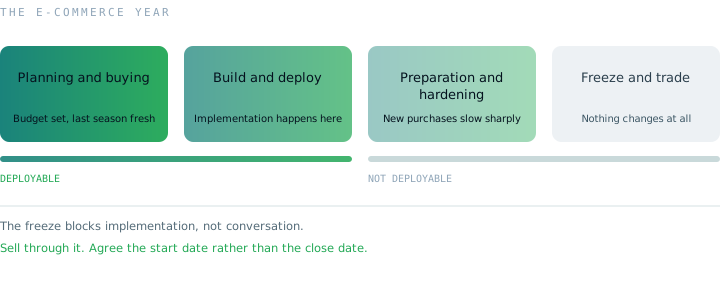
The year, in four parts
- Planning and buying. Once trading ends and the numbers are known, next year’s budget is set and last season’s failures are still fresh. This is the strongest buying window in the category, and it is short.
- Build and deploy. The long middle stretch, when implementation actually happens. Anything sold in the window gets installed here, and anything not installed by the end of it waits.
- Preparation and hardening. Attention turns to readiness. New purchases slow sharply, and the question shifts from whether a tool is good to whether it can be live and stable in time.
- Freeze and trade. Nothing changes. The team is operating rather than buying, and even enthusiastic buyers go quiet for reasons that have nothing to do with the deal.
Exact dates vary by market and by category, and a business selling to Indian retail runs a different festive calendar from one selling into the US holiday season. The shape is the same and the dates are not, which makes the calendar a qualification field worth capturing per account rather than assuming.
The mistake that costs a quarter
The common error is reading the freeze as a stalled deal and responding with the tactics used on stalled deals: more follow up, a discount to force a decision, an escalation to someone more senior.
None of it works, because the blocker is not commercial. A discount does not make a checkout change safe in the third week of November. What it does is teach a buyer that waiting produces a better price, which is a lesson they will apply every year after that.
The second version of the same error is internal. A pipeline full of accounts that all went quiet for calendar reasons looks like a performance problem on a dashboard, and teams frequently respond by increasing activity in the exact weeks when activity converts worst. Reporting that separates seasonal stalls from genuine ones is the difference, and the general version of that discipline is how to audit a sales pipeline.
What to do during the freeze
Sell. Just do not try to deploy.
The freeze blocks implementation, not conversation, and it happens to be the period when the problem is most visible to the buyer. A brand watching its checkout struggle under load is experiencing the pain that the product addresses, in real time, with numbers in front of them. That is a better discovery conversation than any available in the quiet months, provided it is framed around the next cycle rather than this one.
- Agree the start date, not the close date. A deal signed during the freeze with an agreed January implementation slot is a stronger commitment than a verbal yes in October with nothing booked.
- Capture what went wrong while it is happening. Specific failures observed during peak are the raw material for the buying window that follows, and they will be vaguer by January.
- Book the engineering time in advance. The implementation queue in the new year fills quickly, and a deal with a slot beats a deal with a signature.
- Do not force a close. Pushing during the freeze converts a good relationship into a defensive one, and the buying window is weeks away.
Not the same as the logistics peak
Both markets have a peak season freeze and the mechanics differ enough to matter, which is worth stating since the two are frequently sold into by the same teams.
In logistics the freeze is operational: freight volumes rise and nobody will change a system that is moving goods. In e-commerce it is commercial: the storefront is the revenue, and the risk is to the transaction itself rather than to the operation behind it. The consequence is that the e-commerce freeze is stricter about anything customer-facing and more relaxed about back-office tooling, where the logistics version is close to the opposite. The freight version is covered in why the logistics software sales cycle runs long.
Related reading
On the committee and the agency dynamic in this sector, see selling to e-commerce and D2C brands. On meetings booked and not held, which worsens in the run up to peak, see why booked meetings do not happen.
The vertical page is B2B lead generation for e-commerce and D2C.
Frequently asked questions
When do e-commerce brands stop buying software?+
Well before the holiday trading period, because teams stop accepting changes in order to test and stabilise ahead of it. By the time the season is publicly underway, the decision to freeze was taken weeks earlier. The freeze covers new code on the storefront, checkout changes, migrations and often new tools altogether, and it removes roughly a quarter from the deployable year.
Should you keep selling during the retail code freeze?+
Yes. The freeze blocks implementation rather than conversation, and it is the period when the problem is most visible to the buyer, who is watching it happen with numbers in front of them. What changes is the goal: agree the start date rather than push for a close, book the implementation slot for the new year, and capture the specific failures while they are happening, because they will be vaguer by January.
When is the best time to sell e-commerce software?+
The window that opens once trading ends and the numbers are known, when next year's budget is being set and last season's failures are still fresh. It is the strongest buying period in the category and it is short. Exact timing varies by market, since a business selling into Indian festive retail runs a different calendar from one selling into the US holiday season.
Why do e-commerce deals go quiet in the autumn?+
Usually for calendar reasons rather than commercial ones. Treating it as an ordinary stalled deal and responding with more follow up, a discount or an escalation does not work, because the blocker is not price. A discount teaches the buyer that waiting produces a better price, which is a lesson they will apply every year afterwards.
Is the e-commerce freeze the same as the logistics peak season?+
No, and the difference matters for teams selling into both. In logistics the freeze is operational: freight volumes rise and nobody changes a system that is moving goods. In e-commerce it is commercial: the storefront is the revenue and the risk is to the transaction itself. The e-commerce version is stricter about anything customer-facing and more relaxed about back-office tooling.
Leads arriving, pipeline not following
Thirty minutes on whether it is a targeting, qualification or follow up problem.
Book 30 minutesWritten with AI assistance from Shobhit Gupta’s notes and client work, then reviewed and edited by Shobhit Gupta on .