
GrowthStack Advisory / Resources / Selling to E-commerce Brands
Selling to e-commerce and D2C brands: who actually decides
The short answer
Selling software to an e-commerce or D2C brand differs from ordinary B2B software in three ways that change the motion. Revenue is attributed daily, so a buyer can see what a decision did within a week and expects a proof window rather than a business case. The agency is frequently the real gatekeeper, because it holds the media budget and the implementation time even though it does not sign. And the buying committee is small but oddly shaped: the person with the pain, the person with the budget and the person with the engineering time are three different people, and the third one is usually the reason a deal stalls.
- Attribution is daily, so buyers expect proof rather than a business case
- The agency gatekeeps without ever signing anything
- Engineering time is the constraint that stalls deals, not budget
- Small committee, but the three roles rarely sit with one person

Founder, GrowthStack Advisory. Ran sales development at Locus, GoComet and Landmark’s Logistiq division, and has since delivered for Easyship, ConvertCart and WorkStore. LinkedIn.
· 7 min read
Three things that are different from ordinary B2B software
The category is treated as generic B2B SaaS more often than it should be, and three differences change how the motion has to run.
Revenue is attributed daily. An e-commerce operator can see what happened to conversion rate this week. That makes them unusually comfortable with a short proof window and unusually impatient with a twelve month business case, which inverts the normal enterprise sequence: proof first, justification afterwards.
The stack is crowded and visible. Most brands already run a dozen tools that touch the storefront, and a buyer can list them. Anything new has to explain what it replaces or where it sits, because the reflex question is not whether it works but whether it conflicts.
Peak season freezes everything. A calendar constraint that is close to absolute, and it is severe enough to have its own page: selling e-commerce software around peak season.
Who is actually in the room
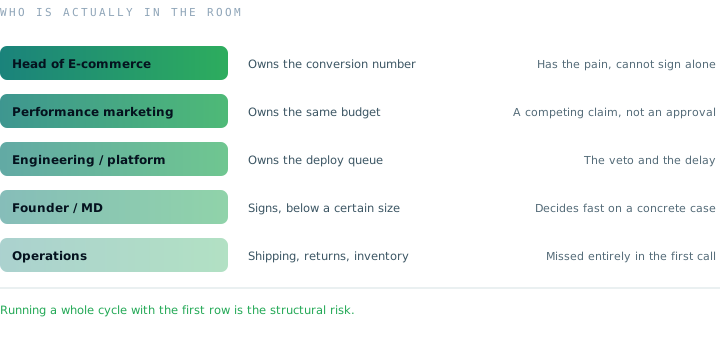
The committee is smaller than in enterprise software and it is shaped differently, because the three functions that matter rarely sit with one person.
- Head of E-commerce or Growth. The pain. Owns the conversion or retention number, feels the problem daily, and is the right first conversation. Frequently cannot sign alone.
- Performance marketing. The budget, and a rival claim on it. Any spend on tooling is spend not going into acquisition, so this is a genuine trade rather than an approval. Worth understanding as a competing priority rather than an obstacle.
- Engineering or the platform owner. The veto and the delay. Rarely enthusiastic, rarely consulted early, and the most common reason a signed deal does not go live.
- Founder or managing director. The signature, below a certain size. At smaller brands the founder still signs anything material, and they decide fast when the case is concrete.
- Operations or fulfilment, where the product touches shipping, returns or inventory rather than the storefront. Often missed entirely in the first call.
The structural risk is running an entire cycle with the first person on that list, who has the pain and cannot clear the other three. The mechanics of mapping that properly are the same as in the logistics buying committee, a different market with the same failure.
The agency problem
A large share of D2C brands run growth through an external agency, and this is the part most sellers get wrong.
The agency does not sign and is not the customer, so it is easy to treat as a contact to route around. In practice it often holds the media budget, does the implementation work, and is asked by the brand whether the tool is any good. That is functional gatekeeping without any formal authority.
Two consequences follow. Selling past an agency to the brand is frequently a way of acquiring an active opponent inside the account, since the agency will be asked for an opinion and has just been bypassed. And an agency that likes the product is the single most efficient channel in this category, because it sits across many brands with the same problem, which makes it worth treating as a partner motion rather than as an obstacle in one deal.
The practical move is to establish early whether an agency is involved and what it owns, which is a qualification question and belongs in the written criteria rather than being discovered in month two.
Engineering time is the constraint, not budget
Deals in this category stall after agreement more often than they are lost during it, and the reason is almost always implementation capacity rather than money.
A brand can approve a subscription in a week and wait a quarter for someone to install it. Meanwhile the seller reports a closed deal that produces no usage, no result and no renewal case, and nobody inside the brand experiences this as a problem because the product was never live.
Three questions asked during the cycle rather than after it change the outcome materially. What does implementation require from your team. Who does that work. When does their calendar allow it. A buyer who cannot answer the second and third has not yet bought, whatever the paperwork says, and treating that as a disqualifying condition is exactly the kind of criterion that belongs in a written standard, as set out in BANT vs MEDDIC vs your own.
What proof looks like in this category
Because attribution is fast, the proof that persuades is a short measurable window rather than a reference customer or a projected return.
That cuts both ways. A buyer who can measure in a week can also disprove in a week, which means the offer only works where the product genuinely moves a number that fast. Where it does not, promising a quick proof window sets up a failure at the earliest possible moment.
The second form of proof that carries weight is specificity about similar brands: same category, similar order volume, similar platform. Generic logos do less work here than in most B2B categories, because operators know that a tactic which works at one scale frequently does not at another.
On named client work, ConvertCart, a conversion rate optimisation company serving eCommerce brands in the US and UK, had the outbound team and the activity already in place. What moved was meeting quality, follow up discipline and reporting, with no-show rates falling from 44% to 15%, which is the more common shape of the problem in this sector than a shortage of demand.
Related reading
The calendar constraint has its own guide: selling e-commerce software around peak season. On meetings that get booked and not held, see why booked meetings do not happen.
The vertical argument and the named results are on B2B lead generation for e-commerce and D2C.
Frequently asked questions
Who is the buyer for e-commerce software?+
Usually the Head of E-commerce or Growth, who owns the conversion or retention number and feels the problem daily. They frequently cannot sign alone. Performance marketing holds a competing claim on the same budget, engineering or the platform owner holds an effective veto and the power to delay indefinitely, and at smaller brands the founder still signs anything material. Where the product touches shipping, returns or inventory, operations belongs in the first call and is usually missed.
Should you sell through or around a D2C brand's agency?+
Through. The agency does not sign and is not the customer, but it often holds the media budget, does the implementation and is asked by the brand whether the tool is any good, which is gatekeeping without formal authority. Selling past it usually creates an active opponent inside the account. An agency that likes the product is also the most efficient channel in the category, because it sits across many brands with the same problem.
Why do e-commerce software deals stall after signature?+
Implementation capacity rather than budget. A brand can approve a subscription in a week and wait a quarter for someone to install it, which produces a closed deal with no usage, no result and no renewal case. Three questions asked during the cycle change this: what implementation requires from their team, who does that work, and when their calendar allows it. A buyer who cannot answer the last two has not really bought.
What proof works when selling to e-commerce brands?+
A short measurable window, because attribution in this category is daily and buyers are comfortable proving rather than projecting. The risk is symmetrical: a buyer who can measure in a week can disprove in a week, so this only works where the product genuinely moves a number that fast. Specificity about similar brands, meaning same category, order volume and platform, does more work than generic logos.
How is selling to e-commerce different from other B2B software?+
Three ways. Revenue is attributed daily, so buyers expect a proof window rather than a twelve month business case. The stack is crowded and visible, so the reflex question is whether a new tool conflicts rather than whether it works. And peak season freezes deployment for a long stretch of the year, which is a calendar constraint closer to absolute than in most categories.
Leads arriving, pipeline not following
Thirty minutes on whether it is a targeting, qualification or follow up problem.
Book 30 minutesWritten with AI assistance from Shobhit Gupta’s notes and client work, then reviewed and edited by Shobhit Gupta on .