
GrowthStack Advisory / Resources / Founder to Rep Handoff
Handing sales from founder to rep without losing the close rate
The short answer
Close rates drop during a handover for a reason that has little to do with the rep’s ability. What transfers in a CRM is the account and the stage. What does not transfer is why the account is in play, what was promised informally, which objection was parked rather than answered, and which champion is genuine. A rep given records without that context re-asks questions the buyer has already answered, which the buyer experiences as the company forgetting who they are. The fix is a staged transfer over about four weeks, deal context written down rather than narrated, and a founder role that is defined in advance instead of decided weekly.
- Stage transfers, context does not. That gap is the whole problem
- Write the context down, because a verbal handover survives about a week
- Four weeks, staged, rather than an introduction email
- Define the founder’s remaining role before the first week, not during

Founder, GrowthStack Advisory. Ran sales development at Locus, GoComet and Landmark’s Logistiq division, and has since delivered for Easyship, ConvertCart and NuVista AI. LinkedIn.
· 7 min read
Why the close rate drops, and what it is not
A drop during a handover is normal and is usually misread. The instinct is to conclude that the rep cannot sell, or that the customers only ever wanted to speak to the founder. Both are occasionally true and neither is the common cause.
The common cause is information loss. A CRM record transfers an account name, a stage and a set of notes. It does not transfer the reason the account entered the pipeline, the offhand commitment made on a call in March, the objection that was parked rather than resolved, or the fact that the enthusiastic contact has no budget authority and the quiet one does.
The buyer experiences the gap immediately. A new person arrives and asks questions that were answered four calls ago, which reads as the company having forgotten them. Trust built over months is spent in a single conversation, and the deal slows for reasons nobody in the company can see, because internally the handover looked complete.
What actually needs to transfer
Per open deal, written down rather than narrated, because a verbal handover survives roughly a week before the details blur. Building what transfers, and hiring the rep who receives it, is the SDR team build engagement.
- Why this account, in one sentence. The trigger that made them worth contacting. Without it a rep cannot reconstruct the argument under pressure.
- What has been promised, including informally. Timelines, pricing indications, features discussed as though they exist. This is the item most often omitted and the one that causes the most damage when a rep contradicts it.
- The objection that was parked. Almost every live deal has one. If the rep does not know which, they will meet it unprepared at the worst moment.
- Who actually decides. Separate from who is most engaged. The enthusiastic contact and the signing authority are frequently different people, and only the founder currently knows that.
- The real next step and its date. Not the CRM stage. What has been agreed with the buyer and when.
For the accounts that matter, this is fifteen minutes of writing each. Founders resist it because they already know all of it, which is precisely the reason it has to be written down.
The four week sequence
A handover done as an introduction email fails. Staged over about four weeks, with the rep taking progressively more of the conversation, it usually holds.
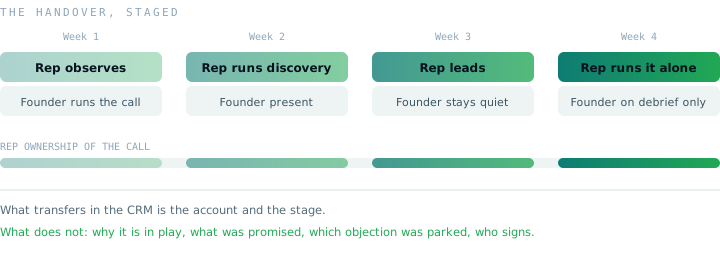
- Week one, the rep observes. They sit on live calls and say very little. The purpose is not training on the product, it is hearing how the founder handles the objection that is not in any document.
- Week two, the rep runs part of the call with the founder present. Usually discovery, because it is the most structured and the least risky part to get wrong.
- Week three, the rep leads and the founder attends. The founder’s job is to stay quiet unless something is about to go wrong, which is harder than it sounds and is the part most founders fail.
- Week four, the rep runs it alone and debriefs afterwards. The founder is available between calls rather than on them.
The introduction to the buyer matters as much as the internal mechanics. A transfer framed as the founder stepping back reads as a downgrade. A transfer framed as the buyer gaining a dedicated point of contact who is present full time, with the founder still involved, reads as an upgrade, and it has the advantage of being true.
Which accounts go first
Not the largest, and not the smallest either.
Handing over the strategic accounts first risks the revenue the company can least afford to lose, on the rep’s least informed week. Handing over only the dormant ones is worse in a quieter way: the rep spends a quarter on accounts that were parked for good reasons, produces nothing, and both sides conclude the hire was a mistake when the input was.
The right first tranche is live, genuinely qualified, and not company-critical. Enough that success is possible and failure is survivable. Where the qualification standard that decides this has not been written down, that is the prior piece of work, covered in choosing a qualification framework.
The founder’s remaining role, defined in advance
Founders should stay involved in sales, and the damage comes from staying involved by instinct rather than by definition.
Written in advance, a founder role might be the largest deals, anything structurally unusual, and any conversation where the product roadmap is genuinely in question. Those are decisions a rep cannot and should not make, and a buyer asking about roadmap commitments is asking for a founder.
Decided weekly, it becomes whichever deal looks most interesting on Thursday. Every individual intervention is defensible and the cumulative effect is that the rep never carries a full cycle end to end, so nobody ever finds out whether they could, including the rep. It also teaches buyers that the real answer comes from the founder, which quietly makes the rep ceremonial.
When to take a deal back
Rarely, and on a rule written before it happens rather than in the moment.
A reasonable rule: the founder re-enters when the buyer asks a question only a founder can answer, such as a roadmap commitment or an unusual commercial structure, and returns the deal afterwards. That is a founder joining a call, not a founder repossessing an account.
Taking a deal back because it is stalling is almost always the wrong call. It removes the rep’s only opportunity to learn to recover a stalled deal, signals to the rest of the team that difficult deals get confiscated, and tells the buyer that escalation works. The deal may well close. The capability does not develop, and the capability was the point of the hire.
How to tell whether it is working
Two comparisons, both run against the founder’s own baseline rather than against an industry number.
First, conversion at each stage for handed-over deals against the founder’s historic rate at the same stage. A uniform drop across every stage suggests a context problem, since the deals were already qualified. A drop concentrated at one stage points at a specific skill or a specific missing piece of information, and is far easier to fix.
Second, cycle length. Handed-over deals slowing down while conversion holds is the early signature of a context gap, because a rep rebuilding an understanding the buyer already provided adds calls rather than losing deals. That will become lost deals a cycle later if nothing changes, which is why velocity is worth watching here specifically, as described in the metrics that predict revenue.
Expect a dip either way. A handover with no dip usually means the deals were not really transferred.
Related reading
The two decisions before this one are when to make your first sales hire and who it should be and, further upstream, the five founder-led sales mistakes that kill pipeline.
Where the handover is complete and the numbers still will not move, the next step is a pipeline audit or, if it looks individual, the five lever diagnostic. The engagement is on founder-led sales.
Frequently asked questions
Why do close rates drop when a founder hands over sales?+
Usually because of information loss rather than the rep's ability. A CRM record transfers the account, the stage and some notes. It does not transfer why the account is in play, what was promised informally, which objection was parked rather than answered, or who actually signs as opposed to who is most engaged. The rep then re-asks questions the buyer answered months ago, which the buyer experiences as the company forgetting them.
How long should a sales handover take?+
About four weeks, staged. Week one the rep observes live calls and says little. Week two they run part of the call, usually discovery, with the founder present. Week three they lead while the founder attends and stays quiet. Week four they run it alone and debrief afterwards. A handover done as an introduction email fails, because the context that matters was never in the records.
Which accounts should a founder hand over first?+
Live, genuinely qualified, and not company-critical. Handing over strategic accounts first risks the revenue the company can least afford to lose during the rep's least informed week. Handing over only dormant accounts is worse in a quieter way, because the rep spends a quarter on accounts parked for good reasons and both sides wrongly conclude the hire was a mistake.
Should a founder stay involved in sales after hiring?+
Yes, but on a subset defined in advance rather than decided weekly. A written role might be the largest deals, anything structurally unusual, and any conversation where the roadmap is genuinely in question. Decided weekly it becomes whichever deal looks interesting that Thursday, and the rep never carries a full cycle end to end, so nobody finds out whether they could.
When should a founder take a deal back from a rep?+
Rarely, and on a rule written before it happens. A reasonable rule is that the founder joins when the buyer asks something only a founder can answer, such as a roadmap commitment, then returns the deal. Taking a deal back because it is stalling is almost always wrong: it removes the rep's only chance to learn to recover a stalled deal, and it teaches buyers that escalation works.
Still carrying sales personally
Thirty minutes on whether what you have is repeatable yet, and what is missing if it is not.
Book 30 minutesWritten with AI assistance from Shobhit Gupta’s notes and client work, then reviewed and edited by Shobhit Gupta on .