
GrowthStack Advisory / Resources / Founder-Led Sales Mistakes
Five founder-led sales mistakes that kill pipeline
The short answer
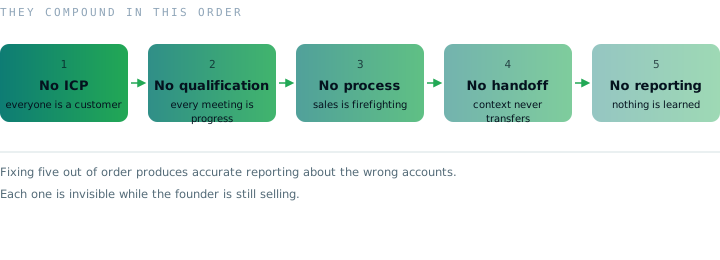
The same five gaps appear in almost every founder-led sales motion: no written ICP, no qualification standard, no repeatable process, no handoff protocol, and no reporting. None of them is a failure of effort, and each one is invisible while the founder is still doing the selling, because a founder compensates for all five instinctively. They only become expensive at the moment someone else is asked to sell. They also compound in a fixed order, which is why fixing the fifth while the first is still broken produces accurate reporting on the wrong accounts.
- All five are invisible while the founder is still selling
- They compound in order, so the sequence of fixes matters
- Everyone is a customer is the first and the most expensive
- Reporting last, because it measures whatever the first four produced

Founder, GrowthStack Advisory. Ran sales development at Locus, GoComet and Landmark’s Logistiq division, and has since delivered for Easyship, ConvertCart and NuVista AI. LinkedIn.
· 7 min read
Why these five, and why they surface all at once
A founder selling is a complete sales system running inside one person. They filter out bad-fit accounts without consulting an ICP, disqualify in the middle of a sentence, adjust the pitch to the objection, and carry the entire pipeline in working memory. None of it is written down because none of it needs to be.
That works until a second person has to do it. At that point every unwritten judgement becomes a gap, and all five surface in the same quarter, which is why the first sales hire so often looks like a hiring failure when it was a documentation failure.
Mistake 1: everyone is a potential customer
Early on this is reasonable. The first customers arrive from anywhere and a founder is right to talk to all of them, because those conversations are how the product finds its shape.
It stops being reasonable the moment someone is hired to prospect. A rep given an open definition of the market will build a list that is wide and shallow, work it diligently, and generate a reply rate that looks like a skill problem on every dashboard. The founder concludes the rep cannot sell. The rep concludes the product is hard to sell. Both are reading a targeting problem as something else.
The correction is unglamorous and fast: read the accounts that have already bought and write down what they share. Not what the market research says, what the closed-won data says. Founders are frequently surprised by the answer, and the surprise is the useful part, because it means the working definition in their head was different from the one their customers demonstrate. The method is on building a B2B ICP sales actually uses.
Mistake 2: every meeting feels like progress
A founder qualifies continuously and invisibly. They hear one sentence, know the deal is not real, and steer the conversation somewhere more useful without ever calling it a disqualification.
With no written standard, a new rep has no equivalent. Their honest interpretation is that a meeting held is a meeting won, so meetings accumulate, pipeline coverage looks strong, and close rate quietly falls because the denominator grew while the numerator did not. That specific pattern, deals promoted into a stage they did not earn, is stage inflation, and it is the most common finding in a pipeline audit.
What resolves it is a written standard including the disqualifying conditions, which is the half most teams skip. A criterion that cannot exclude anything is not a criterion. Choosing between the standard frameworks is covered in BANT vs MEDDIC vs your own.
Applied at Locus, writing that standard down moved MQL to SQL conversion from 10% to 25% with no additional lead volume, which is the clearest available demonstration that the constraint was never lead quality.
Mistake 3: sales is firefighting rather than a system
Founder-led sales is reactive by design. Whatever is loudest gets attention, and because the founder can hold the whole pipeline in their head, nothing is genuinely lost.
A rep cannot do that, and the failure mode is silence rather than rejection. Most deals in an early motion are not lost to a competitor or a no. They are lost to a follow up that never happened, because nobody defined how many touches, over how long, through which channels, and when to stop. Speed matters more than most founders expect, which is the subject of speed to lead.
A process here does not mean a heavy playbook. It means a written answer to four questions: what happens when a lead arrives, how many attempts before it is set aside, what the exit rule is, and where the record lives. The sequence itself is covered in how to structure a B2B outbound sequence.
Mistake 4: the handoff nobody designed
The handover from founder to rep is usually treated as an introduction rather than a transfer, and it is the single most expensive item on this list because it destroys deals that were already working.
What transfers easily is the account list. What does not transfer is why each account was in play, what was promised informally, which objection was parked rather than answered, and which champion is real. A rep who inherits records without that context will re-ask questions the buyer has already answered, which reads to the buyer as the company forgetting who they are.
There is a second version of the same mistake that appears later, when the founder keeps taking back whichever deal looks interesting that week. Each individual intervention is defensible and the aggregate effect is that the rep never owns a complete cycle, so nobody ever finds out whether they could. Both versions, and the four week sequence that prevents them, are in the founder to rep handoff.
Mistake 5: nothing is measured, so nothing is learned
While the founder sells, reporting is genuinely unnecessary. They know which deals are real, which are stalling and why, without consulting anything.
Once someone else sells, that knowledge is gone and nothing replaced it. The usual response is to install a dashboard reporting whatever the CRM counts easily, which means activity: emails sent, calls made, meetings booked. Those are inputs a rep controls completely, which is exactly why they keep rising while pipeline does not.
Four numbers are enough: conversion between consecutive stages, conversion by lead source, SQL to close rate, and the count of deals older than two sales cycles. Which metrics earn a permanent place and which only look useful is set out in the sales metrics that actually predict revenue.
The order matters more than the list
These are not five independent problems. Each one feeds the next, so fixing them out of sequence wastes the work.
- ICP first, because qualification criteria written for the wrong market will faithfully qualify the wrong accounts.
- Qualification second, because a process built around an undefined standard automates inconsistency.
- Process third, because a handoff into no process hands over a list rather than a motion.
- Handoff fourth, because it is the point at which the first three are tested by someone who did not write them.
- Reporting last, because it measures whatever the other four produced. Installed first, it produces accurate numbers about the wrong accounts, which is worse than no numbers, since it carries the authority of data.
Related reading
This is one of three guides for founders carrying revenue personally. The others are when to make your first sales hire and who it should be and handing sales from founder to rep without losing the close rate.
The engagement that works through all five in order is on founder-led sales.
Frequently asked questions
Why does founder-led sales stop working?+
Not because the founder runs out of hours. Because the knowledge of who is worth contacting, what to say, what disqualifies an account and what a real buying signal sounds like exists in one head and has never been written down. The company can then only add capacity by diluting the thing that works. It is a documentation problem that presents as a hiring problem.
What is the most expensive founder-led sales mistake?+
Treating everyone as a potential customer. It is first in the sequence, so every later fix inherits it: qualification criteria written for the wrong market will faithfully qualify the wrong accounts, and a process built on top will scale that error. It is also the cheapest to correct, because the answer is already sitting in closed-won data.
Should a founder write a sales playbook before hiring?+
Not a full playbook, but four things: a written ICP drawn from closed-won, qualification criteria including disqualifying conditions, the message with the reasoning behind it, and stage definitions. Anything more is usually premature, and anything less means the first rep builds a private version of the process that nobody can inspect until the quarter closes.
Why do first sales hires miss target so often?+
Because they are frequently executing correctly against a broken input. A rep working a list that was never filtered against an ICP will miss regardless of ability, and their reply rate will look like a skill problem on every dashboard. Establishing whether the constraint is the rep or the system is a separate investigation, and it should happen before any coaching plan is written.
What should a founder measure once someone else is selling?+
Four numbers: conversion between consecutive stages, conversion by lead source, SQL to close rate, and the count of deals older than two sales cycles. Activity counts such as emails sent and meetings booked are inputs a rep controls completely, which is why they keep rising while pipeline does not.
Still carrying sales personally
Thirty minutes on whether what you have is repeatable yet, and what is missing if it is not.
Book 30 minutesWritten with AI assistance from Shobhit Gupta’s notes and client work, then reviewed and edited by Shobhit Gupta on .