
GrowthStack Advisory / Hands-on experience / Hiring your first SDR
How to hire your first SDR
Hire your first SDR once three things are true: a written definition of a qualified lead, a message with a reply rate you can explain, and someone who will manage the role. Hire for research depth, call resilience, written clarity and coachability, which a charismatic interview does not reveal. Pay a base plus variable split weighted toward base, and tie the variable to qualified meetings that survive to a second conversation, never to meetings booked. Plan a ramp of three to six months, with milestones at weeks one, two and four. Shobhit Gupta recruited the founding inside sales team at Landmark Group’s Logistiq division, and hired two SDR managers while GoComet’s team grew from 10 to 23.
- Do not hire to discover the process. Hire to execute one you can already describe.
- Coachability, written clarity and tolerance for repetition predict early SDR success. Industry experience predicts far less.
- Pay on qualified meetings that survive to a second conversation, never on meetings booked.
- Ramp is three to six months. Budget for it, or you will fire someone in month two for a system problem.

Written and maintained by Shobhit Gupta, Founder and Principal GTM Consultant at GrowthStack Advisory. Ten years running sales development and revenue operations at Locus, GoComet and Landmark Group's Logistiq division. Published LinkedIn.
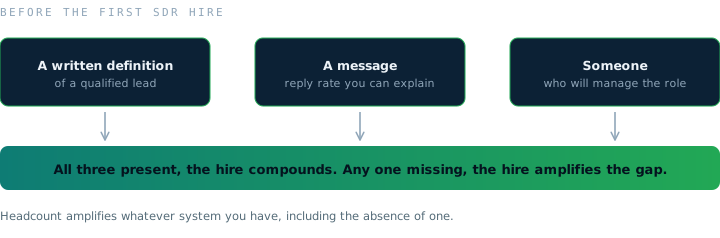
Hire your first SDR once three things are already true: a written definition of a qualified lead, a message with a reply rate you can explain, and someone who will actually manage the role.
Headcount amplifies whatever system you have, including the absence of one. Hiring before those three exist is the most common and most expensive mistake in early B2B outbound.
When should you hire your first SDR?
Hire your first SDR once three things are already true: you have a written definition of a qualified lead, a message with a reply rate you can explain, and someone who will actually manage the role. Miss any one and the rep inherits no system, and nobody can diagnose why they are missing.
The founder-led sales signal matters more than a revenue threshold. If you as a founder can close consistently but cannot describe why you close, the process is not documented enough to hand over. Write down the five questions you always ask on a first call. If you cannot, that is the work to do before the job ad goes up.
The three things to fix before you hire
1. A broken ICP means hiring scales the wrong targeting. 2. Messaging that does not resonate means more reps produce more silence. 3. Weak qualification means headcount accelerates pipeline inflation rather than revenue. In each case the rep is not the variable that failed.
What to look for, and what does not matter
The profile that predicts early SDR success is coachability, written clarity and tolerance for repetition. Industry experience and a polished CV predict far less than most founders expect at this stage.
| Signal | Why it predicts performance | How to test it |
|---|---|---|
| Coachability | The first 90 days are almost entirely feedback absorption. | Give live feedback mid-interview and see whether the next answer changes. |
| Written clarity | Most outbound is written. Clear thinking shows up in a three-line email. | Ask for a cold email to a real account on your list, written live in ten minutes. |
| Tolerance for repetition | The job is the same motion, executed well, every day. | Ask what they did on their least motivated day in their last role. |
| Curiosity about the buyer | Discovery quality separates a meeting from a qualified meeting. | Ask them to interview you about your product for five minutes. |
| Prior SaaS SDR experience | Useful, but frequently means unlearning another company's playbook. | Weight it lightly. Ask what they would keep and what they would drop. |
An interview structure that reveals execution
- Screen (20 min). Motivation, written communication, basic pattern-matching to your market.
- Live writing exercise (30 min). A real account from your list, ten minutes, then a feedback round and a rewrite. The rewrite is the actual test.
- Mock call (30 min). One realistic objection from your market. You are watching whether they ask a second question or reach for a pitch.
- Reverse interview (15 min). They interview you about the product. Weak candidates ask about the tool; strong ones ask about the buyer.
Onboarding: week 1, 2 and 4 milestones
- Week 1 - product, ICP, and the written qualification standard. They should be able to recite what a qualified lead is by Friday.
- Week 2 - shadow real calls, write sequences against your framework, first supervised sends.
- Week 4 - running their own cadence, first call reviews, first coaching cycle. Ramp expectations should be explicit, not implied.
Ramp to full productivity typically takes three to six months. Budget for that, or you will fire someone in month two for a system problem. What coaching looks like after week 4 is covered in SDR coaching and playbooks.
How should you pay your first SDR?
Early-stage SDR compensation is usually a base plus variable split, weighted more heavily toward base than at a larger company, because a new rep at a startup carries system-building risk that is not theirs to control. Tie the variable to qualified meetings that survive to a second conversation, never to meetings booked. Paying on meetings booked is how you buy pipeline inflation.
Early warning signs it is not working
- Activity is on target and reply rate is near zero. That is a list or message problem, not a rep problem.
- Meetings are booked but AEs disqualify most of them. Your qualification standard is not being enforced.
- The rep cannot explain why an account is on the list. Targeting was never transferred properly.
- Coaching notes repeat month over month. Feedback is not converting into behaviour change.
References
Shobhit Gupta carried this role himself before managing it, as an SDR at mFino and then Avancer Corporation, where he delivered over 100 SQLs in five months and $50K in revenue from three clients. The interview structure above is built around what actually predicted output in that seat, which was follow-up discipline and the willingness to work a written list, not polish in the room.
What does a first SDR hire look like in practice?
Some companies call this role BDR rather than SDR. The distinction is usually cosmetic at the first hire, where one person is doing all of prospecting, qualification and handoff regardless of the label on the contract. If you would rather not build this alone, the SDR team build engagement covers the foundation, the hiring process and the ramp. Write the playbook the hire will run first; the template is in the SDR playbook. Writing that playbook with your team is sales playbook development.
Shobhit Gupta recruited and onboarded the founding inside sales reps for Landmark Group's SaaS division, building the interview loop, the ramp plan and the reporting alongside the hire rather than after it. At GoComet he hired two SDR managers while the team scaled from 10 to 23, which is the same problem one level up.
The pattern in both: the hire worked where the qualification standard and the message already existed, and struggled where the role was expected to invent them.
One benchmark worth holding a new hire against: contacting a web lead within five minutes rather than thirty made a rep about twenty one times more likely to qualify it (Oldroyd, MIT Sloan and InsideSales.com, 2007). Response discipline is learnable in week one, and it is the cheapest thing a first SDR can be measurably good at.
This guide covers the prospecting hire specifically. Whether the first hire should prospect at all, or close, is the prior decision, and it is settled in when to make your first sales hire and who it should be.
Frequently asked questions
When should a startup hire its first SDR? +
Once you have a written definition of a qualified lead, a message with a reply rate you can explain, and a person who will actually manage the role. The founder-led sales signal matters more than a revenue threshold: if you can close consistently but cannot describe why you close, the process is not documented enough to hand over yet.
What should you look for when hiring an SDR? +
Coachability, written clarity, tolerance for repetition and genuine curiosity about the buyer. Test coachability by giving live feedback mid-interview and watching whether the next answer changes. Test written clarity with a ten-minute cold email to a real account from your list, followed by a feedback round and a rewrite; the rewrite is the actual test.
How long does it take an SDR to ramp? +
Three to six months to full productivity is normal. Set explicit week 1, week 2 and week 4 milestones rather than implied ones: product and qualification standard in week 1, shadowing and supervised sends in week 2, own cadence and first coaching cycle by week 4.
How should you pay an SDR at an early-stage startup? +
A base plus variable split, weighted more toward base than at a larger company, because a new rep at a startup carries system-building risk that is not theirs to control. Tie the variable to qualified meetings that survive to a second conversation. Paying on meetings booked buys pipeline inflation.
Should we hire an SDR or use an agency first? +
If the system does not exist yet, neither. Build the qualification standard, account list and messaging first, then decide who executes. If the system does exist and the only constraint is volume, an agency is faster; if you need to own the playbook long term, hire. The full comparison is on our SDR agency vs GTM consultant page.