
GrowthStack Advisory / Scaling an SDR Team
How to scale an SDR team without losing output
The short answer
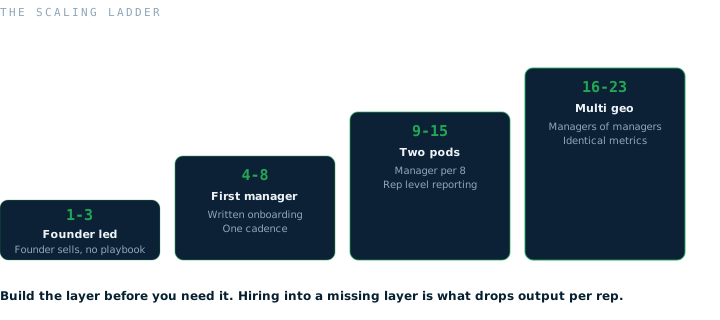
Scale an SDR team by putting the management layer, onboarding and operating cadence in place before the headcount arrives. One manager can properly coach around six to eight reps, so hire managers ahead of the curve. Give every new rep the same 30 day onboarding, run one cadence across every geography, and track output per rep rather than headcount, because that shows whether the scale is real. That is how GoComet’s global SDR team grew from 10 to 23 across the US, India and South East Asia while output rose from 2 to 6 SQLs per rep per month, with two SDR managers hired along the way.
- One manager per six to eight reps, hired ahead of the curve rather than after
- A 30 day structured onboarding so rep six ramps as fast as rep two
- One operating cadence across every geography, with identical metrics
- Hire against written behaviours, not interview charisma
Doubling headcount is the easy part. Keeping output per rep steady while you do it is where most teams fail.

Founder, GrowthStack Advisory. 10+ years building SDR and GTM systems at Locus, GoComet, and Landmark Group. LinkedIn.
· 4 min read
What breaks first when an SDR team doubles?
Scaling an SDR team from 10 to 23 people across the US, India, and Southeast Asia exposed the same three failure points every time: onboarding that relied on watching a senior rep, a manager span that quietly got too wide, and a cadence that worked in one time zone and nowhere else. The same work is available as an engagement: SDR team build, from the first hire to a managed team.
Output per rep is the metric to protect. Average monthly productivity went from 2 to 6 SQLs per rep during that scale up, which only happened because the system was built before the hiring, not after.
How should you hire when scaling an SDR team?
Define the behaviours that predict success in your specific motion: research depth, call resilience, written clarity, coachability. Score candidates against those consistently. A charismatic interview tells you very little about whether someone will send a well researched sequence on a Thursday afternoon in week seven. The same scoring logic applies when hiring that first SDR, except there you have no internal benchmark to score against yet.
When do you need SDR managers?
One manager cannot coach fifteen reps properly. Past roughly eight, coaching quality drops and the weakest performers stop improving. Promote or hire SDR managers ahead of the headcount curve, and give them a defined weekly rhythm: pipeline review, call reviews, and one to ones that look at leading indicators rather than only outcomes.
How long should SDR onboarding take?
- Week one product, ICP, and the qualification standard
- Week two tooling, sequences, and shadowing with a scorecard
- Week three live outreach on a limited account set with daily review
- Week four full territory with a defined ramp target
Structured onboarding is what makes rep six as good as rep two. See SDR coaching and playbooks.
Response discipline is the part of onboarding worth front-loading, because it is both learnable in week one and unusually well evidenced. Contacting a web lead within five minutes rather than thirty made a rep roughly twenty one times more likely to qualify it (Oldroyd, MIT Sloan and InsideSales.com, 2007). It is the cheapest thing a new rep can be measurably good at by day five.
Run one cadence across every geography
Multi geo teams drift apart quickly. A single weekly operating cadence, with local timing but identical structure and identical metrics, keeps a distributed team comparable and coachable.
How the function was actually built
The brief at GoComet, a Series A logistics SaaS company, was not "hire more SDRs". It was to open new markets and build the function that could sell into them, with three things measured: the efficiency of each rep, the pipeline the team produced, and the existence of the function itself, including the people in it. That third KPI is the one most scaling plans leave implicit, and it is usually the one that decides the other two.
The markets were the constraint that shaped everything else. Alongside the existing business, the team had to open the United States, Europe, and Indonesia, the Philippines and Singapore in Asia Pacific. A team selling into five time zones is not a bigger version of a team selling into one, and the differences show up first in infrastructure rather than in messaging.
So the first quarter went on assessment rather than hiring. That meant auditing the tech stack that already existed, deciding what genuinely had to be added, and specifying calling infrastructure that worked across each of those markets rather than assuming the domestic setup would extend. Dialling into Southeast Asia and dialling into the United States are different technical problems, and discovering that after the reps arrive wastes their first month.
The structure was deliberately three layers rather than two. Individual contributors doing the prospecting, SDR managers owning coaching and consistency, and a leader above them responsible for the number moving month on month. Most teams scale the first layer and postpone the second, which is precisely the failure described further up this page.
Hiring ran as a project with its own dependencies rather than as a request to a recruiter. Writing the job descriptions, working with HR to source and screen, and going to the founders for budget approval before any of it, because a headcount plan without signed-off budget is a wish. The managers were brought in ahead of the reps they would manage, which is the single sequencing decision this page argues for most strongly.
None of that is glamorous, and all of it happened before a single new sequence was written. That is the point. The system was built before the hiring, not after.
Model your own headcount
The arithmetic above is worth running against your own numbers before you write a hiring plan. Work backwards from the revenue target to deals, SQLs, meetings, replies and prospects, then divide the resulting touches by what one rep genuinely does in a day. The answer is usually larger than expected, and it is dominated by reply rate rather than by close rate.
The free pipeline capacity calculator does this for you. It also cross-checks the SQLs per rep per month your inputs imply against the 2 to 6 range described on this page, which is the fastest way to find out that an assumption is wrong.
What does scaling from 10 to 23 actually look like?
The team described here was titled SDR. Organisations that call the same role BDR face an identical set of constraints, because what breaks at scale is the management ratio and the onboarding standard, not the job title.
The numbers in this guide come from GoComet, where Shobhit Gupta led global sales development across the US, India and South East Asia. The team went from 10 to 23 people. Two SDR managers were hired before the headcount arrived, not after, and average output rose from 2 to 6 SQLs per rep per month across the same period. The engagement also delivered $1.2M in new revenue plus $300K from key account management.
The management layer is the part teams skip. Doubling headcount without it means the person who used to coach every rep now coaches none of them, and output per rep falls even as the total climbs. If you are weighing this against automating the role instead, the five parts of the job an autonomous AI BDR would have to replace are worth reading before you decide.
“Shobhit is a person who always motivates and has the ability to make other people achieve their goals. In a short span of time, he brought out the true professional from me. I got to learn a lot from him. He is always calm, in all the situations and tells others to follow the same path in order to achieve success.”
Akshay Trehan · Account Manager, BrowserStack · reported to Shobhit directly ·
References
Related reading
- Sales playbook development, as an engagement
- SDR coaching and playbooks
- The experience behind this guide
- Outreach vs Salesloft, when a team is ready for one
- The B2B sales tool stack, by team size
- Plan your SDR scale up
Holding output per rep steady through a scale up depends on being able to tell a system constraint from an individual one. The five lever SDR diagnostic is how that call gets made.
Where the manager capacity described above does not exist internally, it can be rented before it is hired: fractional sales leadership.
Questions
How many SDRs should one manager handle?+
Around six to eight for genuine coaching depth. Beyond that, call reviews and one to ones become status updates and performance improvement slows.
How long should SDR ramp take?+
A 30 day structured onboarding with a defined ramp target works well for most B2B motions, with full productivity typically expected by the end of the second or third month.
How do you build an SDR function for multiple international markets?+
Start with infrastructure rather than headcount. At GoComet the brief covered the United States, Europe, and Indonesia, the Philippines and Singapore, and the first quarter went on auditing the existing tech stack and specifying calling infrastructure that worked in each of those markets before anyone was hired. Dialling into Southeast Asia and dialling into the United States are different technical problems, and discovering that after the reps arrive wastes their first month.
What should you measure when scaling a sales development team?+
Three things, and the third is usually left implicit. Efficiency per rep, total pipeline produced, and the state of the function itself including the people in it and the management layer above them. Teams that measure only the first two scale the individual contributor layer and postpone the manager layer, which is what causes output per rep to fall as headcount rises.
Tell us where the funnel leaks
We will tell you whether it is a targeting, execution, or qualification problem, and what it would take to fix.
Book a CallWritten with AI assistance from Shobhit Gupta’s notes and client work, then reviewed and edited by Shobhit Gupta on .