
GrowthStack Advisory / Best AI Tools for Sales Development
Best AI BDR software in 2026
The short answer
The AI BDR platforms most teams evaluate in 2026 fall into four groups. Autonomous AI BDRs that run the whole outbound loop: 11x, Artisan, AiSDR and Amplemarket. AI research and writing tools that keep a rep in the loop: Regie.ai, Autobound and Clay. Engagement platforms with AI built in: Apollo, Outreach and Salesloft. AI dialers: Nooks and Orum. Choose the group before the product. For most teams the right buy is a CRM the team updates, one data and prospecting tool, a sequencer matched to the motion and a general AI assistant across all of them, because the autonomous tools automate sending, which was rarely the constraint. Apollo, Outreach and Salesloft are the three Shobhit Gupta has run in live SDR teams.
- Buy the process, not the category, a stack bought ahead of a written ICP amplifies the gap
- One data tool, one sequencer, until the motion is proven and a manager exists
- The AI layer sits across the stack, it is not a ninth tab to buy and onboard
- Automation applied to a weak process scales it, it does not fix it

Founder, GrowthStack Advisory. 10+ years building SDR and GTM systems at Locus, GoComet, and Landmark Group. LinkedIn.
· 6 min read
What is an AI SDR or AI BDR, exactly?
The label covers two very different things, and the difference decides whether the purchase makes sense.
The first is AI-assisted sales development. A rep keeps the job and a model does the slow parts: researching an account, drafting a first message from real inputs, summarising a call, suggesting who to prioritise. That is the layer described above, and it is where nearly all of the realised value sits today.
The second is an autonomous AI BDR. The product claims the whole loop: it builds the list, writes the message, sends it, reads the reply, handles the objection and books the meeting, with a human reviewing rather than doing. This is what most software sold as an AI SDR or AI BDR is selling, and it is priced against the salary of the person it claims to replace.
Those two propositions get the same name in marketing copy and almost never in a contract. Before evaluating anything, work out which one you are being sold, because the first is a productivity tool and the second is a headcount decision.
For the market-level numbers behind this, including adoption, headcount and touches per contact, see AI in outbound: the 2026 benchmarks.
What does an AI sales development stack look like in 2026?
Sales development rep and business development rep describe the same job in most organisations, so this applies whether your team is called SDR or BDR. Every tool below has been configured and run in a live revenue team . That list is Salesforce, HubSpot, Outreach, Salesloft, Lemlist, Klenty, ZoomInfo, Apollo, Lusha, LinkedIn Sales Navigator and Linked Helper, across the SDR and revenue operations functions at Locus, GoComet and Landmark Group.
| Job | What to use | When |
|---|---|---|
| CRM | HubSpot | Most early and growth-stage teams. Salesforce once you have real complexity and an implementer. |
| Data | Apollo | Small to mid-sized teams. ZoomInfo for larger US-focused orgs with budget. |
| Sequencing | Lemlist or Klenty | Until you have managers and multiple sequences per segment. |
| Engagement | Outreach or Salesloft | Roughly twenty reps with a management layer. Before that, overkill. |
| Research | LinkedIn Sales Navigator | From day one. Do not expect exportable contact data. |
| AI layer | ChatGPT or Claude | Across all of the above, not beside them. |
That is five tools and an assistant. Most teams asking which AI tool to buy already own more than this and are using less of it.
Where does AI actually help in sales development?
The shift worth making is not a purchase. It is using a general assistant across the tools a rep already has open, which shows up in eight places: account research before a list is built, ICP analysis against closed-won and closed-lost, persona work drawn from what buyers said on calls, personalisation where the input is real research rather than a merge field, reply analysis across a campaign, objection handling built from objections your team is hearing, lead prioritisation, and workflow automation across the CRM and sequencer.
Every one of those already existed as a task. The layer makes them faster and more consistent, which is a different proposition from buying a tool that promises to do the job instead of your team. The full argument is in AI is a layer across your GTM stack, not another tool in it.
Do AI SDR tools actually work?
Most of what is sold as an AI SDR automates sending. Sending was never the constraint. The constraints are list quality, a message a rep can defend on a call, and a written definition of qualified that two reps would apply identically.
The context makes this worse rather than better. A typical buying group for a complex B2B solution now runs to six to ten decision makers, each arriving with four or five independently gathered pieces of information (Gartner), and buyers spend only about 17% of the buying process in front of suppliers (Gartner). More automated outreach into a group like that, without a targeting and qualification standard underneath it, produces volume and no pipeline.
Where the qualification standard was fixed first, the numbers moved without any new tooling. At Locus, MQL to SQL conversion went from 10% to 25%. For Easyship, subscription conversions rose 20% inside the first month, contributing roughly $100,000 in pipeline.
What an autonomous AI BDR would actually have to replace
It helps to be specific about the job rather than the title. Scaling GoComet's sales development team from 10 to 23 people across the US, India and South East Asia, average output moved from 2 to 6 SQLs per rep per month. That gain did not come from reps sending more email. It came from five things, and any product claiming to replace the role has to do all five, not the easiest one.
- Deciding who is worth contacting. Not filtering a database by firmographics, which is the easy half, but knowing that this account changed a system last quarter and therefore has a reason to talk now. Trigger quality is the difference between a list and a target list.
- Saying something the buyer recognises as their own situation. Not a merge field, and not a rephrased value proposition. The message has to name a symptom the reader is currently living with.
- Judging a reply. "Send me some information" is usually a polite no. "We looked at this last year" is often the best lead in the inbox. Reading the difference is the job.
- Applying a qualification standard consistently. Deciding, the same way every time, whether a conversation is genuinely an opportunity. Two reps applying the same written standard should reach the same answer, and most teams cannot do this even with humans.
- Feeding what it learns back upstream. Noticing that one segment replies and another does not, and changing the targeting rather than the send volume.
Current autonomous products are strongest on the second item and weakest on the first, third and fifth. That is the shape of the category. It also explains a pattern worth knowing before you buy: these tools tend to demo extremely well, because a demo is a personalisation problem, and to disappoint in month three, because month three is a judgement problem.
The constraint is worth stating once more, since it is the thing most easily automated and the thing that was never actually broken. Sending was never the bottleneck. Where the qualification standard was fixed first, the numbers moved with no new tooling at all. At Locus, MQL to SQL went from 10% to 25%. For Easyship, subscription conversions rose 20% inside the first month.
When an AI BDR is genuinely the right buy
There are real cases, and pretending otherwise would be as useless as the vendor claims.
- You have a proven motion and cannot hire fast enough. If the list, the message and the qualification standard already work and the only missing input is hours, automation multiplies something that is already correct. This is the case where it pays.
- Your motion is genuinely high volume and low consideration. Small deal sizes, a short cycle, a buyer who decides alone. Judgement matters less, so automating it costs less.
- You are reactivating a dormant list. Low expectations, high volume, and nobody is worse off if the message is generic.
And the case where it reliably fails: you do not yet have a repeatable motion and you are hoping the software will supply one. Automation applied to a weak process scales the weakness. If two of your reps would qualify the same lead differently today, an AI BDR will not resolve that disagreement, it will encode whichever answer it was configured with and apply it a thousand times.
The test before you sign anything: can you write down, in one page, who you are targeting and why, what you say to them, and what counts as qualified? If yes, tooling will help you go faster. If no, you are buying a faster way to send the wrong message to the wrong list.
How do AI BDR tools actually streamline the process?
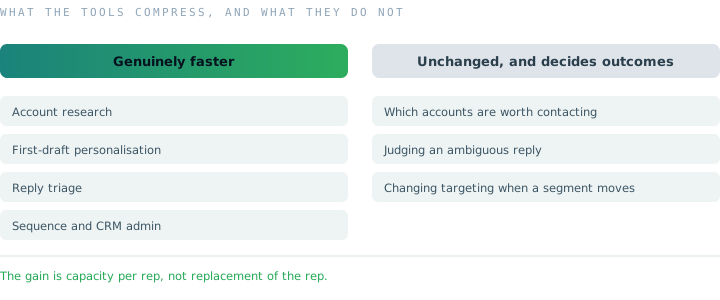
Specifically, and the specificity matters, because they compress four tasks and leave three untouched.
What genuinely gets faster:
- Account research. Pulling together what a company does, what changed recently and who does what, from sources a rep would otherwise open in eleven tabs. This is the largest real saving and the least disputed.
- First-draft personalisation. Turning that research into an opening line. A draft, not a send. The rep still decides whether the observation is worth making.
- Reply triage. Sorting an inbox into out-of-office, unsubscribe, referral, objection and genuine interest, so a rep reads the ten replies that matter rather than sixty.
- Sequence and CRM admin. Logging, task creation, moving records between stages. Unglamorous, and collectively a real fraction of a rep’s week.
What does not get faster: deciding which accounts are worth contacting at all, judging an ambiguous reply, and noticing that one segment is responding while another is not and changing the targeting because of it. Those are the three that decide outcomes, and they are all judgement rather than throughput.
So the accurate way to describe the gain is capacity per rep, not replacement of the rep. A team that reclaims research and admin time and spends it on more accounts is genuinely better off. A team that reclaims that time and sends more of the same message to the same list has bought a faster way to be ignored.
One caution that follows directly. Because the compressed tasks are the visible ones, the productivity gain shows up immediately in activity metrics and only later, if at all, in pipeline. Judge these tools on meetings held and opportunities created, not on emails sent or accounts researched, or you will conclude they work months before you know whether they did.
Which AI BDR software has the highest conversion rates?
Nobody can answer this from public data, and the reason tells you how to evaluate.
No vendor in this category publishes conversion data on a comparable basis. What gets published is a case study: one customer, their list, their market, their product, their definition of a booked meeting, self-reported, with no control group and no disclosure of what the rate was beforehand. A headline reply rate from a vendor page is a fact about that customer’s list quality, not about the software. Two companies running the identical tool against different lists will report numbers far enough apart that the average of them means nothing.
The deeper problem is attribution. Conversion in outbound is determined mostly by who you contacted and what you said about their situation. The tool influences the second of those and not the first. So even a genuine improvement after adopting one is confounded with whatever else changed that quarter: a new list, a new market, a new person writing the copy.
What to do instead is measure it yourself, on your own list, with a defined sample size decided before you start. Run the tool against one segment and your existing motion against a comparable one, for long enough that the difference is distinguishable from noise. At the reply rates typical of cold outbound that takes more volume than most teams expect, which is exactly why intuition fails here. The free cold email A/B test calculator gives you the sends required for the difference you care about.
If a vendor cannot tell you the base rate their customer started from, they have not told you anything about their software.
The AI BDR platforms, compared by what they take over
Twelve platforms come up in almost every AI BDR evaluation. They are grouped below by the part of the job each one takes over, because that decides fit far more than any feature list does.
Three of them, highlighted, were configured and run in live SDR teams at Locus, GoComet and Landmark Group. The other nine are mapped from each vendor’s own published materials, checked on 26 September 2026. That tells you what each product is for and how it is sold. It does not tell you how well it performs on your list.
| Platform | What it takes over | How it is priced |
|---|---|---|
| Autonomous AI BDRs: the whole outbound loop | ||
| 11x (Alice) | Prospecting, research and personalised multichannel outreach. A second agent, Julian, handles inbound qualification and scheduling. | Not published. Sold through a demo. |
| Artisan (Ava) | Finds and enriches leads, writes and sends outreach, handles replies and books meetings. | Not shown on its public pages. Sold through a demo. |
| AiSDR | Research, prospecting and personalised email and LinkedIn outreach, run by its Ami agent. | Published. From $250 a month for 200 researched contacts; $900 and $2,500 plans on quarterly terms. |
| Amplemarket (Duo) | Multichannel sequences with AI copywriting, AI voice messages and drafted inbox replies. | From $600 a month on an annual term. Larger plans quoted on request. |
| AI research and writing: the rep stays in the loop | ||
| Regie.ai | Agents for research, enrichment, message drafting and queued calling. | Free tier. Paid plans from $41 a month, a per-seat Team plan, and custom Enterprise. |
| Autobound | Buying-signal data, over 700 signals across 35 feeds, feeding personalised outreach. | Credit packs from $19, with 1,000 free credits on signup. |
| Clay | Enrichment from more than 150 data providers, plus AI research and workflow automation. | Free plan. From $167 a month (Launch) and $446 a month (Growth). |
| Engagement platforms with AI built in: for a mature motion | ||
| Apollo Run in a live SDR team | Contact data, sequencing and dialling, with an AI assistant and background agents. | Free plan. Paid from $49 per user a month, billed annually. |
| Outreach Run in a live SDR team | Sequences and engagement, with Research, Personalization, Deal and Revenue agents. | Per user, quoted by sales. |
| Salesloft Run in a live SDR team | Cadences, Rhythm prioritisation, conversation intelligence and AI agents. | Quoted by sales. |
| AI dialers: the calling part of the job | ||
| Nooks | Parallel and power dialling with answer detection, plus sequencing, signals and AI coaching. | Quoted by sales. |
| Orum | Parallel and power dialling with AI coaching and roleplay. | Quoted by sales, with a nine-seat minimum. |
The grouping matters more than the names. The first group sells the whole loop, which is exactly where the constraint does not sit: sending was never the bottleneck. The second augments a rep rather than replacing one, and it is the lower-risk way to collect the real time savings. The third is where most teams already are, and where the AI features arrive without a separate purchase.
If you are choosing between groups rather than between products, the deciding question is who writes the qualification standard and who owns the list. Neither of those is something any platform on this page does for you.
Why these are mapped rather than ranked
Because nine of the twelve have not been run here inside a live revenue team, and a score is a claim about performance. The eleven tools in the stack table, including the three highlighted in the map, were configured and operated at Locus, GoComet and Landmark Group, which is why those recommendations come with conditions rather than scores.
Reviewing an autonomous BDR product properly means running it against a real list, for a full attribution cycle, and comparing the pipeline it produced to what a rep produced on the same segment. Anything short of that is a summary of the vendor’s own website, which is why the map above sticks to what each vendor states about its own product and price, dated, and does not grade them. The category also moves fast enough that a product review written today describes something different in six months.
What is offered instead is the part that does not go out of date: what the job consists of, which parts are automatable, and the questions to ask a vendor. If you are running an evaluation now and want a second opinion on the results, that is what the GTM diagnostic is for.
What I have not implemented
Clay, Smartlead and Cognism come up constantly in this category and I have not run a full client implementation of any of them, so this page will not tell you how to configure them.
On Clay specifically I do have a view. The use cases are real, particularly combining multiple data sources, enrichment and AI research in one workflow. The caution is that it over-engineers quickly, and if your ICP, messaging and process are not already clear it becomes a more sophisticated way to automate a weak process. Smartlead fits teams and agencies running higher-volume cold email across many inboxes. Cognism comes up for European prospecting and compliance-sensitive teams. Those are observations about where each fits, not recommendations from implementation.
What order should you buy in?
Account list first, from your last twenty wins and losses. Then messaging a rep can defend on a call. Then the qualification standard, written down. Only then the tooling, and only the smallest stack that supports the motion you have proven.
Done in that order the layer compounds, because it is improving work that was already correct. Done in the other order you will have spent a budget sending more of the same emails to a slightly better researched version of the wrong list. That sequence is the same one behind the first 90 days of outbound.
References
- Gartner. B2B Buying Survey, buying group size and information gathering. 2024.
- AiSDR. Pricing. Accessed 26 September 2026.
- Amplemarket. Pricing. Accessed 26 September 2026.
- Regie.ai. Pricing. Accessed 26 September 2026.
- Autobound. Pricing. Accessed 26 September 2026.
- Apollo. Pricing. Accessed 26 September 2026.
- Outreach. Pricing. Accessed 26 September 2026.
- Salesloft. Pricing. Accessed 26 September 2026.
- Nooks. Pricing. Accessed 26 September 2026.
- Orum. Pricing. Accessed 26 September 2026.
- 11x. Product overview. Accessed 26 September 2026.
- Artisan. Product overview. Accessed 26 September 2026.
- Clay. Pricing and credit model. Accessed September 2026.
- LinkedIn. Sales Navigator plans and features. Accessed September 2026.
Related reading
- The B2B sales tool stack, by team size
- Best sales tools for startups
- AI is a layer, not another tool
- Salesforce in Claude, and what it actually changes
- The HubSpot Prospecting Agent, and what it costs
- Apollo’s AI agents: what they do, and how to set them up
- Claude for sales teams: the connectors and the Sales plugin
- Case studies: what changed after the system was built
Companies selling AI products have a second problem on top of buying them, which is that their own buyers are now sceptical of the category. That work is on GTM and outbound for AI startups.
Questions
What are the best AI tools for sales development in 2026?+
A CRM the team will update (HubSpot or Salesforce), one data and prospecting tool (Apollo for most teams, ZoomInfo for larger US-focused orgs), a sequencer matched to your motion (Lemlist or Klenty, or Outreach and Salesloft once you have managers), LinkedIn Sales Navigator for research, and a general AI assistant such as ChatGPT or Claude running across all of them. The assistant is the part that changes output, because it improves work reps already do rather than adding another tool to adopt.
Do AI SDR tools replace SDRs?+
No. They automate sending, which was never the constraint. List quality, a defensible message and a written qualification standard are, and none of those are solved by more automated outreach.
Is Clay worth it for a growth-stage team?+
It can be, for teams that genuinely need to combine multiple data sources, enrichment and AI research in one workflow. The caution is that it over-engineers quickly. If your ICP, messaging and outbound process are not already clear, it becomes a more sophisticated way to automate a weak process.
What is the difference between an AI SDR and an AI BDR?+
Nothing meaningful. Sales development rep and business development rep describe the same job in most organisations, and vendors use AI SDR and AI BDR interchangeably. The distinction that matters is not the label but whether the product assists a rep who keeps the job, or claims to run the whole prospecting loop autonomously and is priced against that rep's salary.
Can an AI BDR replace a human SDR?+
Not for a considered B2B purchase, on current evidence. The job has five parts: choosing who is worth contacting, saying something the buyer recognises, judging a reply, applying a qualification standard consistently, and feeding what it learns back into targeting. Autonomous products are strongest at writing the message and weakest at trigger quality, reply judgement and closing that loop. They tend to demo well, because a demo is a personalisation problem, and to disappoint by month three, because month three is a judgement problem.
When is buying an AI BDR actually worth it?+
When the motion already works and the only missing input is hours, when deal sizes are small and the buyer decides alone, or when reactivating a dormant list. It reliably fails when a team has no repeatable motion yet and hopes the software will supply one, because automation applied to a weak process scales the weakness rather than fixing it.
What is the best AI BDR software?+
There is no single answer, and any page claiming one has not run these tools against a real list. The useful question is which of two things you are buying: an assistant that speeds up a rep who keeps the job, or an autonomous product priced against that rep's salary. The first is where nearly all realised value sits today. For the second, the deciding factor is whether you already have a repeatable motion, because automation applied to a weak process scales the weakness.
How can AI BDR tools streamline my process?+
They compress four tasks: account research, first-draft personalisation, reply triage, and sequence and CRM admin. They do not compress the three that decide outcomes: choosing which accounts are worth contacting, judging an ambiguous reply, and changing the targeting when one segment responds and another does not. The accurate description of the gain is capacity per rep rather than replacement of the rep, and it should be judged on meetings held rather than on emails sent.
Which AI BDR software has the highest conversion rates?+
No vendor publishes conversion data on a comparable basis, so the question cannot be answered from public sources. Published figures are single customer case studies, self-reported, with no control group and no disclosure of the base rate before adoption. Conversion in outbound is driven mostly by who you contacted and what you said about their situation, and the tool influences only the second. Measure it on your own list with a sample size defined before you start.
What are the best AI BDR tools for scaling sales?+
Scaling is the one case where these tools clearly pay, but only in a specific condition: the list, the message and the qualification standard already work, and the missing input is hours. Then automation multiplies something already correct. Where a team has no repeatable motion yet and hopes the software will supply one, the same tools scale the problem instead.
Tell us where the funnel leaks
We will tell you whether it is a targeting, execution, or qualification problem, and what it would take to fix.
Book a CallWritten with AI assistance from Shobhit Gupta’s notes and client work, then reviewed and edited by Shobhit Gupta on .