
GrowthStack Advisory / Resources / Lead Scoring
Lead scoring that predicts revenue, not engagement
The short answer
Most lead scoring models rank engagement because engagement is what the marketing automation platform can see. Opens, clicks, page views and form fills are all measures of how much attention someone paid, and attention correlates weakly with the ability to buy. A model worth having is built from closed-won and closed-lost data, weights fit attributes far above behaviour, and is validated by checking whether high scoring leads actually closed at a higher rate than low scoring ones. Most teams never run that check, which is why scores drift into decoration. Where there is not yet enough closed data to fit a model, the right answer is a written qualification standard rather than a score.
- Engagement is visible, which is why it dominates most models
- Fit over behaviour, in roughly that order of weight
- Validate against closed-won, or the score is decoration
- Under 100 closed deals, write criteria instead of scoring

Founder, GrowthStack Advisory. Ran sales development at Locus, GoComet and Landmark’s Logistiq division, and has since delivered for Easyship, ConvertCart and WorkStore. LinkedIn.
· 7 min read
Why most models score the wrong thing
A lead scoring model tends to be built from whatever the marketing automation platform already tracks, and what it tracks is behaviour: email opens, link clicks, pages viewed, documents downloaded, forms completed.
Every one of those measures attention rather than capacity to buy. A student researching a dissertation, a competitor evaluating your positioning and a consultant assembling a shortlist all generate exemplary engagement scores. So does a genuinely interested buyer at a company ten times too small to afford the product.
The effect is a score that ranks people by how much time they spent on your website, handed to a sales team as though it ranked them by likelihood of closing. Reps work the top of the list, find it no better than the middle, and stop trusting the number, usually within a quarter. After that the model persists in the CRM as an unused field, which is the most common end state for lead scoring.
Fit and behaviour are not the same axis
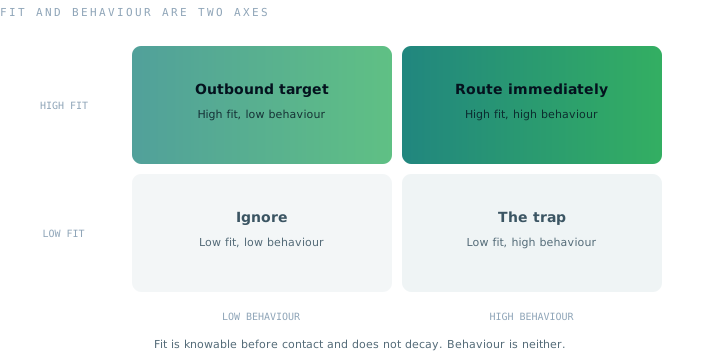
Collapsing both into a single number is the structural mistake, because they answer different questions and a high total can mean either.
Fit asks whether this company could be a customer: size, sector, geography, the operational characteristic that makes the product relevant, the presence of a system you integrate with. It is stable, knowable before any interaction, and largely determines whether a deal is possible.
Behaviour asks whether now is the moment. It is volatile, only exists after contact, and determines timing rather than possibility.
Kept separate, the pair is directly actionable. High fit with low behaviour is an outbound target, and the volume of them tells you whether the problem is awareness. Low fit with high behaviour is the trap, and it is where most teams waste effort, because the lead looks urgent and cannot buy. High on both is the only combination that deserves immediate routing, and how that routing should work is covered in inbound lead routing.
Building one from closed-won, not from opinion
The model should be fitted to your own outcomes rather than assembled in a workshop, and the process is closer to reading data than to designing a system.
- Start with closed-won. Take every deal that closed in the last year or two and list what the accounts share. Fit attributes come out of this, and the answer is frequently not what the team would have guessed.
- Then read closed-lost, separated by reason. Lost on price is a different signal from lost because the buyer was never able to implement, and only the second belongs in a fit score.
- Weight by discrimination, not by importance. An attribute shared by every closed-won deal and by every lost one predicts nothing, however important it feels. The useful attributes are the ones where won and lost differ.
- Keep it small. Five or six fit attributes and three or four behavioural signals. Models with forty inputs cannot be debugged, and nobody can explain why a given lead scored what it did, which is what makes a score trusted or ignored.
The attributes that emerge are usually the same ones that belong in the ICP, which is why the two documents should be built together rather than separately, using the ICP framework. A score that disagrees with the written ICP means one of the two is wrong.
Negative scoring and decay, the two omissions
Two mechanisms are missing from most models and both matter more than adding another positive signal.
Negative scoring. A model that can only add points will eventually rank a persistent bad-fit lead above a new good-fit one, purely through accumulated activity. Students, competitors, job applicants, existing customers browsing support pages and companies below the size threshold should subtract rather than be left neutral. This is the same discipline as writing disqualifying conditions into a qualification standard, described in choosing a framework.
Decay. Behavioural points should expire. Someone who read three pages in March and nothing since is not warm, and without decay their score says otherwise indefinitely. Fit points should not decay, because a company’s size and sector do not change because a quarter passed. That asymmetry is another reason to keep the two scores apart.
The check almost nobody runs
A scoring model is a prediction, and a prediction that is never tested against outcomes is an opinion in a database.
The test is one calculation. Take the leads scored in a past period, long enough ago that their outcome is known, group them by score band, and compare close rates across the bands. If high scoring leads did not close at a meaningfully higher rate than low scoring ones, the model does not work and the team was right not to trust it.
Two failures show up regularly. A model where every band converts identically, which means it is measuring noise. And one where the middle band outperforms the top, which usually means engagement is dominating the total and the highest scores are going to researchers rather than buyers.
Rerun it every couple of quarters, because a model fitted to last year’s customers describes last year’s market. The broader point about metrics being validated rather than assumed is in the sales metrics that actually predict revenue.
When not to score at all
Lead scoring is a way of ranking more leads than a team can work. Where that is not the situation, it adds machinery and removes nothing.
Below roughly a hundred closed deals there is not enough data to fit anything meaningful, and any model built from a smaller sample encodes the team’s assumptions while lending them the authority of a number, which is worse than stating the assumptions plainly. Where lead volume is low enough that every lead gets worked anyway, ranking them changes nothing except the order.
In both cases the correct artefact is a written qualification standard with explicit disqualifying conditions, applied by a person. It does the same job, and it can be debated and corrected in a sentence. On named client work it is how WorkStore's qualification rate moved from 5% to 30%. Neither involved a scoring model.
Related reading
The rate a scoring model is ultimately judged on is MQL to SQL conversion. What happens to a lead once it clears the bar is inbound lead routing and speed to lead.
The reporting layer this sits inside is GTM analytics and sales reporting, and the definition work it depends on is ICP, persona and messaging.
Frequently asked questions
Why does lead scoring not work for most teams?+
Because the model scores engagement rather than fit. Opens, clicks, page views and downloads are what the marketing automation platform can see, and all of them measure attention rather than capacity to buy. Students, competitors, consultants building shortlists and companies far too small to afford the product all generate excellent engagement scores, so reps find the top of the list no better than the middle and stop trusting the number.
Should fit and behaviour be one score or two?+
Two. They answer different questions and a single total hides which one is driving it. Fit asks whether this company could ever be a customer and is knowable before any interaction. Behaviour asks whether now is the moment and only exists after contact. Kept separate, high fit with low behaviour is an outbound target and low fit with high behaviour is the trap most teams waste effort on.
How do you build a lead scoring model?+
Fit it to your own outcomes rather than designing it in a workshop. Start with closed-won deals from the last year or two and list what those accounts share, then read closed-lost separated by reason, since lost on price is a different signal from lost because the buyer could never implement. Weight attributes by how well they discriminate between won and lost, not by how important they feel, and keep it to five or six fit attributes and three or four behavioural signals.
How do you know if a lead scoring model actually works?+
Take leads scored far enough in the past that their outcome is known, group them by score band, and compare close rates across the bands. If high scoring leads did not close at a meaningfully higher rate than low scoring ones, the model does not work. Two failures recur: every band converting identically, which means the model measures noise, and the middle band outperforming the top, which usually means engagement is dominating the total.
When should you not use lead scoring?+
Below roughly a hundred closed deals there is not enough data to fit anything meaningful, and a model built from less encodes the team's assumptions while lending them the authority of a number. Where lead volume is low enough that every lead gets worked anyway, ranking them changes nothing but the order. In both cases a written qualification standard with explicit disqualifying conditions does the same job and can be corrected in a sentence.
Leads arriving, pipeline not following
Thirty minutes on whether it is a targeting, qualification or follow up problem.
Book 30 minutesWritten with AI assistance from Shobhit Gupta’s notes and client work, then reviewed and edited by Shobhit Gupta on .