
GrowthStack Advisory / Hands-on experience / 90-day outbound plan
The first 90 days of outbound: a week-by-week build plan
Building a B2B outbound engine from zero takes about ninety days, and the order matters more than the effort: ICP and account list first, then messaging, then infrastructure, then launch. GrowthStack built exactly this for NuVista AI, covering markets, ICPs, personas, messaging, tooling and outreach, which produced roughly $50,000 in revenue plus additional qualified opportunities. Ninety days is one full attribution cycle, the shortest window in which the data tells you anything reliable. What derails it is starting in the wrong place. Teams buy the sequencing tool in week one, then spend weeks three to six discovering the domain was never authenticated, or that nobody can name the two hundred accounts that matter. Nothing should be sent in the first two weeks. Shobhit Gupta has run this order for companies in AI, logistics, e-commerce and fintech across India, South East Asia and the United States.
- Do not send anything in the first two weeks. The output of phase one is a written account list, not a persona deck.
- Fix deliverability before messaging. A perfect email in spam converts at zero, and it is the cheapest failure to prevent.
- Change one variable at a time from launch onwards, or you lose the ability to attribute any improvement.
- 90 days is one attribution cycle - the shortest window in which the data tells you anything reliable.

Written and maintained by Shobhit Gupta, Founder and Principal GTM Consultant at GrowthStack Advisory. Ten years running sales development and revenue operations at Locus, GoComet and Landmark Group's Logistiq division. Published LinkedIn.
Building a B2B outbound engine from zero takes about 90 days, and the order matters more than the effort.
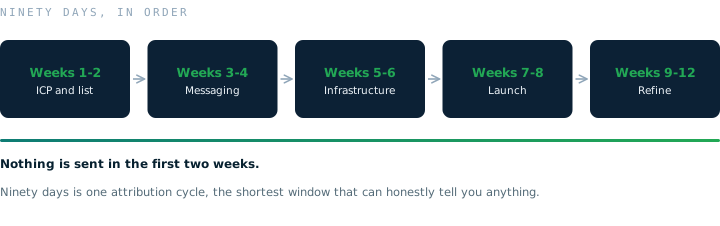
Weeks 1-2 are ICP and the account list. Weeks 3-4 are messaging and sequences. Weeks 5-6 are infrastructure and tooling. Weeks 7-8 you launch and change one variable at a time. Weeks 9-12 are refinement against one full attribution cycle.
Weeks 1-2: ICP and market research
Do not send anything in the first two weeks. Spend them deciding who you are sending to. The output of this phase is a written account list, not a persona document nobody opens again.
Pull your last twenty closed-won and closed-lost deals and look for the pattern: which accounts closed fastest, which churned, and which should never have entered the funnel. That pattern is a sharper ICP than anything a positioning workshop produces. Write explicit disqualifiers as well as qualifiers; knowing who to ignore this quarter is what protects rep capacity later.
- Deliverable: a named list of target accounts, tiered into three levels of effort.
- Deliverable: firmographic, technographic and behavioural criteria, with disqualifiers.
- Deliverable: three personas - economic buyer, champion, blocker - and what each one actually cares about.
If your team cannot name the target accounts without opening a tool, you are not ready for week 3. More detail in how to build a B2B ICP sales will actually use.
Weeks 3-4: messaging framework and sequence build
Write the message from the buyer's situation, not the product. Good copy about the wrong problem is still ignored, which is why reply-rate problems are usually targeting problems wearing a copywriting costume.
Build one problem-led narrative per persona, with a proof point mapped to every claim you make. Then turn each narrative into a sequence: email, LinkedIn and phone designed as one motion rather than three disconnected efforts. Seven touches is a reasonable starting shape - hook, proof point, angle change, then variations - but the count matters far less than whether each touch says something new.
- Deliverable: a messaging framework per persona with mapped proof points.
- Deliverable: one multi-channel sequence per tier, written end to end.
- Deliverable: a follow-up rule that survives a busy week, written down.
Weeks 5-6: list building, tech stack and sending infrastructure
This is the phase teams skip, and it is the one that silently kills the programme. Before a single sequence goes live, your sending infrastructure has to be correct: separate sending domains, SPF, DKIM and DMARC configured, mailboxes warmed, and rate limits set. A perfect message that lands in spam converts at zero.
Configure enrichment so reps stop building lists by hand. Set up CRM stage definitions and the fields you will actually report on - seven is usually enough. Decide now what "qualified" means and enforce it in the CRM rather than in a wiki.
- Deliverable: sending infrastructure verified against a deliverability checklist.
- Deliverable: enrichment and sequencing tools configured and connected to the CRM.
- Deliverable: a written SQL definition, enforced by a required field.
Run the free outbound readiness scorecard before you send anything. Twelve checks across targeting, messaging, execution and measurement.
Weeks 7-8: launch, monitor, early optimisation
Launch small and change one variable at a time. If you change the list, the subject line and the cadence in the same week, you will learn nothing when the number moves. Volume in these two weeks is a diagnostic instrument, not a target.
Watch three numbers: deliverability, reply rate by segment, and meetings that survive to a second conversation. The third is the only one that predicts revenue. Activity looks healthy long before pipeline does.
Weeks 9-12: data-driven refinement and the first attribution cycle
Ninety days is chosen deliberately: it is roughly one full attribution cycle for most B2B deal sizes, which is the shortest window in which the data can actually tell you something. Use these four weeks to cut the segments that are not converting, double the effort on the tier that is, and start coaching to the conversations rather than the dial count.
By day 90 you should be able to answer, with data: which segment converts, which message works, what your true reply rate is, and what a qualified meeting costs you. If you cannot answer those four, the problem is measurement, not effort.
What to do if week 8 looks bad
Diagnose in this order: deliverability first (are the emails arriving), then list quality (are these the right accounts), then message (is anyone replying at all), then qualification (are the meetings real). Teams almost always jump straight to the message, which is third on the list and the most expensive to change.
What derails a 90 day outbound build?
- Sending in week 1. Pressure to show activity destroys the diagnostic value of the first month.
- Hiring reps before the system exists. New reps inherit no playbook and there is nobody to diagnose the miss. See SDR agency vs GTM consultant vs in-house.
- Skipping deliverability. The cheapest failure to prevent and the most common one to hit.
- Changing several variables at once. You lose the ability to attribute any improvement.
Has this ninety day plan been run end to end?
Yes. GrowthStack built the outbound engine from zero for NuVista AI, an AWS Advanced Consulting Partner based in Atlanta offering data platform modernization and AI-powered solutions, with no existing motion, and the same order has since been reused across other AI companies. That covered market selection, ICPs, personas, messaging, tooling and the outreach engine itself, including event specific account segmentation, pre-event prospecting, email and LinkedIn sequences, attendee outreach, post-event follow up, qualification and campaign reporting. What gets written in the first month is set out section by section in the SDR playbook. The infrastructure phase is also available as cold email infrastructure setup.
It produced approximately $50,000 in revenue plus additional qualified opportunities. The phases below are the order that build actually ran in.
For NuVista AI this phase carried an additional layer: event specific account segmentation, pre-event prospecting, attendee outreach and post-event follow up, all sequenced against the same account list built in weeks one and two. Events compress the timeline but do not change the order. The list still comes first.

The full specification for that build, how many sending domains and mailboxes, the data and verification layer, suppression, and reply routing, is in cold email infrastructure setup.
References
- Oldroyd, J.B., McElheran, K. and Elkington, D. The Short Life of Online Sales Leads. Harvard Business Review, March 2011.
- Gartner. The B2B Buying Journey, on buying group size and cycle length.
Ninety days of this work needs someone senior owning it. Where that person is not on the payroll yet, see fractional sales leadership.
Weeks one and two assume you know how large the reachable market is. Sizing it is TAM, SAM and SOM.
Frequently asked questions
How long does it take to build an outbound sales process from scratch? +
About 90 days to a working, measurable engine. Weeks 1-2 go to ICP and the account list, weeks 3-4 to messaging and sequences, weeks 5-6 to sending infrastructure and tooling, weeks 7-8 to launch and early optimisation, and weeks 9-12 to refinement across one full attribution cycle. Teams that compress this usually skip infrastructure and pay for it in deliverability.
What should you do in the first week of outbound? +
Nothing outbound. Spend week one pulling your last twenty closed-won and closed-lost deals and finding the pattern in which accounts closed fastest, which churned and which never should have entered the funnel. That pattern becomes your ICP and your written account list. Sending before the list exists wastes the diagnostic value of the first month.
How many emails should be in an outbound sequence? +
Around seven touches is a reasonable starting shape - a hook, a proof point, an angle change, then variations - but the count matters far less than whether each touch says something new. A three-touch sequence with three distinct angles beats a twelve-touch sequence that repeats the same pitch.
Why is deliverability the first thing to fix? +
Because a perfect message that lands in spam converts at zero, and no amount of copy testing will surface the problem. Separate sending domains, SPF, DKIM and DMARC configuration, mailbox warmup and rate limits should all be verified before a single sequence goes live. It is the cheapest failure to prevent and the most common one to hit.
When should we hire SDRs during a 90-day outbound build? +
After the system exists, not before. A rep hired in week 1 inherits no account list, no message with a known reply rate and no written qualification standard, so nobody can diagnose why they are missing. Build the engine, prove it with whoever you have, then hire against a documented playbook.