
GrowthStack Advisory / Resources / Three activities
Pipeline comes from three activities working together
The short answer
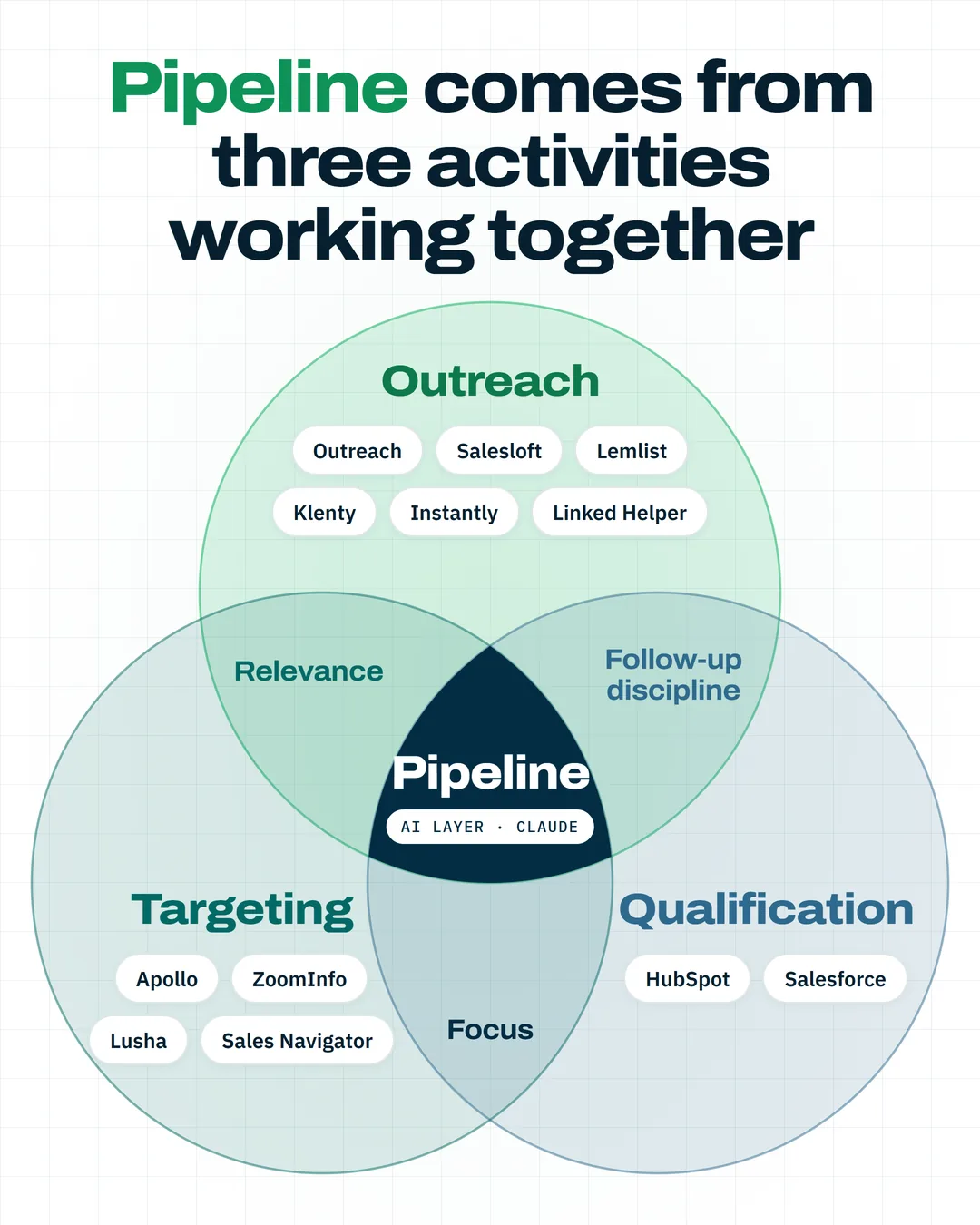
Pipeline comes from three activities working together: targeting, outreach and qualification. Targeting decides who is worth contacting. Outreach decides what gets said, and when. Qualification decides what counts as pipeline. Every tool in a sales stack serves one of the three, and most teams buy tools for one of them, then wonder why the number does not move. The results show up where the activities overlap: targeting and outreach make a message relevant, outreach and qualification make follow-up consistent, and targeting and qualification keep effort on the accounts that close. The practical rule is to find the weakest of the three and fix that one first. AI belongs across all three, not as a fourth tool beside them.
- Three activities, and every tool serves one of them
- Results show up in the overlaps, not inside any single circle
- Fix the weakest activity first, not the one with the newest tool
- AI runs across all three, rather than sitting beside them

Founder, GrowthStack Advisory. Ran sales development at Locus, GoComet and Landmark’s Logistiq division, and has since delivered for Easyship, ConvertCart and WorkStore. LinkedIn.
· 6 min read
1. Targeting: who is worth contacting
You know your market. The question is which accounts inside it close fastest, and that answer comes from your own closed deals rather than from a firmographic filter.
- What it decides. Which accounts go on the list, which people inside them, and in what order they are worked.
- What good looks like. A written account list, rebuilt from your last twenty wins and losses, that reps work instead of whoever replied last.
- The tools that serve it. Apollo and ZoomInfo for contact data, Lusha for direct numbers, and LinkedIn Sales Navigator for research.
The method is set out in the B2B ICP framework, and sizing the list you are left with is covered in TAM, SAM and SOM.
2. Outreach: what gets said, and when
Outreach is the part most teams over-invest in, because it is the part most visibly automated. Sending was never the bottleneck. What gets said, to whom, and how the sequence holds together is.
- What it decides. The message per segment and persona, the channels, the cadence, and when to stop.
- What good looks like. Copy, sequence, sending infrastructure and list quality separated and tested in order, one variable at a time.
- The tools that serve it. Outreach and Salesloft for teams with a management layer, Lemlist, Instantly and Klenty for leaner email motions, and Linked Helper for LinkedIn.
The structure of a sequence is in how to structure a B2B outbound sequence, and the infrastructure underneath it is in the cold email deliverability checklist.
3. Qualification: what counts as pipeline
Qualification is the activity most often left undefined, and the one whose absence does the most damage. Without a written standard, every rep applies a different bar and the pipeline report stops meaning anything.
- What it decides. Which conversations become opportunities, and which are closed out early.
- What good looks like. A standard written down, trained, and enforced at stage exit, so two reps would grade the same lead identically.
- The tools that serve it. HubSpot or Salesforce, configured so the stage definitions are enforced rather than aspirational.
How to write the standard is the sales qualification framework, and the rate it is judged on is MQL to SQL conversion.
Where the results show up
Each activity fails on its own. The results appear only where they meet.
| Overlap | What it produces | What breaks without it |
|---|---|---|
| Targeting and outreach | Relevance: the right message reaching the right account. | The right accounts, contacted with a message that does not land. |
| Outreach and qualification | Follow-up discipline: interest turned into a held meeting. | Meetings booked that never happen, or happen and stall. |
| Targeting and qualification | Focus: effort kept on the accounts that close. | A busy pipeline full of accounts that were never going to buy. |
Follow-up is where the gap is most measurable. Speed to lead covers the response side, and why booked meetings do not happen covers the confirmation side.
What it looks like in numbers
- Qualification, at Locus. Writing down what “qualified” meant moved MQL to SQL conversion from 10% to 25%, with no additional leads and no new tooling.
- Output, at GoComet. Output moved from 2 to 6 SQLs per rep per month while the team grew from 10 to 23.
- Follow-up, at ConvertCart. Fixing follow-up and the confirmation flow cut meeting no-shows from 44% to 15%.
The Locus result is the clearest case for the argument on this page: the number that moved was a qualification number, and it moved without any change to targeting volume or to the tools. More detail on each is in the case studies.
How to choose what to fix next
Find the weakest of the three activities and buy, build or fix for that one. The symptoms usually point to it.
| What you see | Weakest activity | What to fix first |
|---|---|---|
| Reps work whoever replied last, with no written account list | Targeting | Rebuild the list from your last twenty wins and losses. |
| Reply rates under 2% | Outreach | Separate copy, sequence, infrastructure and list quality, and test them in that order. |
| Meetings booked climbs, closed revenue does not | Qualification | Write the standard down and enforce it at stage exit. |
| Meetings are booked, then do not happen | Follow-up, where outreach meets qualification | Tighten speed to first touch and the confirmation flow. |
If none of these describes you clearly, that is itself a finding, and it usually means the stage definitions are not reliable enough to diagnose from. The fastest way to find out is a pipeline audit.
Where AI fits
AI earns its place in the middle, working across all three activities rather than as a fourth tool beside them. An assistant such as Claude or ChatGPT speeds up research for targeting, drafting for outreach, and record updates for qualification.
What it does not do is decide who is worth contacting or what counts as qualified. Those decisions are the activities themselves. The argument is set out in full in AI is a layer, not another tool, and the clearest production example of it is Salesforce in Claude.
Every tool in the diagram’s three circles has been configured and run in a live SDR team, at Locus, GoComet or Landmark Group.
Related reading
The tool-by-tool view of the whole stack is the B2B sales tool stack, chosen by workflow, and the platforms that claim to automate all three activities are compared in the best AI BDR software.
Frequently asked questions
What are the three activities that produce pipeline?+
Targeting, outreach and qualification. Targeting decides who is worth contacting, outreach decides what gets said and when, and qualification decides what counts as pipeline. Every tool in a sales stack serves one of the three, and pipeline shows up where all three work together.
Which of the three should you fix first?+
The weakest one, and the symptoms point to it. Meetings booked climbing while closed revenue stays flat points to qualification. Reply rates under 2% point to outreach. Reps working whoever replied last, rather than a written account list, points to targeting.
Do you need a separate tool for each activity?+
No. A small team can cover all three with a CRM, one data tool and one sequencer, plus an AI assistant across them. Buying a tool for an activity that is not yet defined on paper automates the gap rather than closing it.
Where does AI fit into the three activities?+
Across all three, not as a fourth tool beside them. An assistant such as Claude or ChatGPT speeds up research for targeting, drafting for outreach and record updates for qualification. It does not decide who to contact or what counts as qualified.
Why does the overlap matter more than any single activity?+
Because each activity fails on its own. Good targeting with weak outreach produces the right accounts and no replies. Strong outreach with weak qualification produces meetings that never close. The results show up only where the activities meet.
Not sure which of the three is weakest
Thirty minutes on where your pipeline is breaking and what it would take to fix.
Book 30 minutesWritten with AI assistance from Shobhit Gupta’s notes and client work, then reviewed and edited by Shobhit Gupta on .