
GrowthStack Advisory / Resources / The 5 most common B2B sales problems
The 5 most common B2B sales problems I see, and how I fix them
The short answer
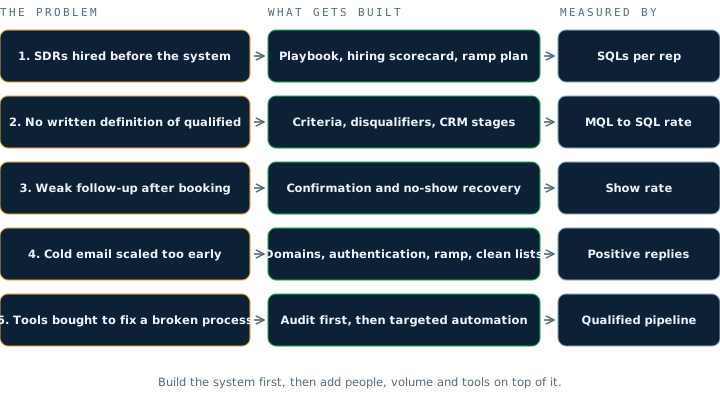
The five problems Shobhit Gupta finds most often in B2B sales teams are: SDRs hired before the system exists, no written definition of a qualified lead, weak follow-up after a meeting is booked, cold email scaled before the infrastructure and the list are right, and tools or AI bought to fix a process that is not working yet. Each has a specific fix: a playbook and ramp plan before the first hire, written qualification criteria enforced in the CRM, confirmation and no-show recovery workflows, a validated sending setup with a ramp, and an audit before any new tool. The fixes have moved real numbers: SQLs per rep from 2 to 6 at GoComet, MQL to SQL from 10% to 25% at Locus, paid lead qualification from 5% to 30% at WorkStore, and meeting no-shows from 44% to 15% at ConvertCart.
- Build the system first, then add people, volume and tools
- Write qualified down and enforce it at every stage
- Follow-up is a process, owned and measured
- A free self-check shows which problems you have

Founder, GrowthStack Advisory. Built and managed SDR teams across the US, Europe, the Middle East and Asia at Locus, GoComet and Landmark Group, and has since worked with Easyship, WorkStore, ConvertCart and NuVista AI. LinkedIn.
· 10 min read
Why the same five keep coming up
Shobhit describes his work as diagnosis before anything else:
“I love to identify problems, discuss, have a conversation, and then diagnose the problem and then provide the active solution if I can.”
Across in-house roles at Locus, GoComet and Landmark Group and client work since, the same five problems account for most of what stops pipeline. They share a cause: people, email volume or software get added before the system underneath them exists. Each section below covers what the problem looks like, how Shobhit describes it, what gets built to fix it, and a result from his own work.
1. Hiring SDRs before the system exists
What it looks like. A company hires SDRs and expects them to work out the ICP, the messaging, the qualification standard and the sales process while also hitting a number. Results vary rep by rep, and nobody can say why.
Shobhit on what broke as GoComet’s team grew:
“When the team grew, the thing that broke is onboarding time and how people are performing. Some people are not performing, some people are performing. So that broke at that point of time when we were growing. We identified a few gaps: one is in hiring, another is in onboarding, and the third is in training, SOPs, managing the tools and everything.”
How it gets fixed. The playbook is built before the first hire, so the SDR inherits a working process.
- Read the last twenty closed-won and closed-lost deals for what they share.
- Write the ICP and buyer personas from that evidence.
- Build messaging and sequences for each segment.
- Write the qualification criteria and the handoff to the AE.
- Create the hiring scorecard, the interview loop and a 30-day ramp plan.
- Set up weekly coaching and performance reviews.
What it produced. At GoComet, average output rose from 2 to 6 SQLs per SDR per month while the team grew from 10 to 23, with two SDR managers hired along the way.
Go deeper: how to hire your first SDR, step by step, the SDR playbook template, and the engagements behind them, SDR team build and sales playbook development.
2. No written definition of a qualified lead
What it looks like. Marketing counts leads, SDRs count meetings booked, and neither number says whether the prospect can become revenue. AEs reject meetings, and the reasons are never recorded.
At Locus, the definition was written down in four criteria. In Shobhit’s words:
“The qualification criteria were these. First, the person should be relevant on the decision bench: either an influencer or a decision maker. The second criterion is that they should have a valid pain point. At Locus they sell AI route planning and route optimization software, so they should have a valid problem of having a number of riders or delivery persons for whom they had to make the route plans, and they’re doing it on Excel sheets and all. The third qualifier is that they are looking for a solution within the next six months, and the fourth is that they have a relevant budget for it.”
How it gets fixed. Qualification is tied to deals that actually closed, and enforced in the CRM.
- Define what makes a lead an MQL, an SQL and an opportunity.
- Write the qualifying questions for your market, the way Locus wrote its four.
- Write the disqualifiers, which are the half most teams skip.
- Set stage-exit requirements and a fixed list of rejection reasons.
- Configure CRM fields and reports around the same definitions.
- Coach SDRs to apply the criteria the same way every time.
What it produced. MQL to SQL conversion at Locus rose from 10% to 25%. For WorkStore, paid media lead qualification rose from 5% to 30% in two months, and for Easyship an audit and new CRM stages gave a 5% improvement in inbound leads to SQL within the first month.
Go deeper: how to improve MQL to SQL conversion, sales qualification frameworks compared and CRM setup.
3. Weak follow-up after the meeting is booked
What it looks like. A prospect books a meeting, receives a blank calendar invite, and nobody owns the days in between. No-shows are written off, and opportunities that stall are quietly abandoned.
Shobhit on what structured sequencing and daily task management gave the SDR teams at Locus and GoComet:
“SDRs could start their day knowing exactly which accounts to engage, which prospects required follow-ups, and what activities needed to be completed across email, calls, and LinkedIn.”
How it gets fixed. Follow-up becomes part of the process, owned by a named person and measured in the CRM.
- Send a confirmation that says why the meeting matters to the prospect.
- Set reminders before the meeting, by email and LinkedIn.
- Give one person ownership of every booked meeting until it happens.
- Run a written no-show recovery sequence.
- Agree the post-meeting follow-up cadence with the AE.
- Track show rate, reschedules and conversion in the CRM.
What it produced. At ConvertCart, over three months, meeting no-shows fell from 44% to 15%, meetings scheduled rose by 20%, and roughly $20,000 was recovered from pipeline that had been written off. The same engagement added LinkedIn as an outbound channel.
Go deeper: how to reduce meeting no-shows and speed to lead.
4. Scaling cold email before the infrastructure and the list are right
What it looks like. Replies are thin, so volume goes up: more emails from the same mailboxes, to lists nobody verified. Deliverability falls quietly, and the copy gets the blame.
“Most teams spend too much time discussing subject lines, AI personalization and sending tools. Very few spend enough time getting their email infrastructure right.”
How it gets fixed. The sending setup and the list are validated before volume, in this order:
- Send from 2–3 secondary domains with 2–3 mailboxes each, and keep the primary domain for regular business email.
- Configure SPF, DKIM and DMARC on every sending domain before the first campaign.
- Build lists from customer and deal data, and verify every one before it is sent to.
- Start at 5–10 cold emails per mailbox per day and build to 20–30 from week 4.
- Write ICP-specific campaigns, and test one change at a time.
- Watch bounces, complaints, positive replies, meetings and qualified pipeline.
“Protect deliverability first, optimize engagement second, and scale only when the data supports it.”
What it produced. For NuVista AI, the domains, mailboxes and authentication were in place before a single sequence went live.
Go deeper: Shobhit’s cold email infrastructure playbook, the deliverability checklist, the first 90 days of outbound and Instantly vs Lemlist.
5. Buying tools or AI to fix a process that is not working
What it looks like. More software, broken workflows automated faster, and an AI SDR switched on before anyone has agreed who the buyer is. On AI specifically, Shobhit is direct:
“An AI BDR isn’t plug-and-play. It needs context about your product, ICP, positioning, buyer personas, objections, and sales process. If those foundations aren’t clear, AI will simply automate an unproven sales motion.”
How it gets fixed. The process is audited first, and technology goes where it removes a defined bottleneck.
- Map the sales workflow from prospecting to closed revenue.
- Find the manual bottlenecks and the systems that do not talk to each other.
- Check what the existing CRM and tools can already do.
- Decide which tasks to automate, and keep judgment, conversations and relationships with people.
- Use AI for account research, prioritization, personalization and admin, with every draft reviewed.
- Measure each change in qualified pipeline.
What it produced. At Locus, the move from Pardot to Salesloft in 2019 brought ICP-based segmentation, personalized sequences, daily task management and consistent follow-up. At Easyship, adding RingCentral for calling while keeping HubSpot gave a reported 5% improvement in call connect rate. In his words:
“The best sales technology isn’t necessarily the most sophisticated or expensive. It’s the one that solves the team’s actual bottleneck and gets adopted.”
Go deeper: how AI BDR tools can streamline your SDR process, the best AI BDR software in 2026, the best sales tools for startups and the B2B sales tool stack.
Which of the five do you have?
Interactive tool
Which of the five problems do you have?
Ten yes or no questions, two for each problem. Every “No” points at a gap, and the result links to the section that covers it.
Answer for how things work today, rather than how they are meant to work.
Where to start
Fix one constraint at a time, starting with the one that costs the most. Shobhit’s rule for choosing it:
“My approach is to fix the highest-impact constraint first. If coverage is weak, we examine how to create more qualified pipeline from the right channels. If pipeline volume is healthy but conversions are poor, we focus on ICP, buying-group alignment, messaging, and qualification. If opportunities are being created but aren’t progressing, we address sales execution, deal strategy, and funnel leakage.”
How that review is run, step by step, is in the pipeline audit guide. GrowthStack runs it as the GTM diagnostic, and the engagements that build each fix are on the pricing page.
Related reading
Frequently asked questions
What are the most common problems in B2B sales teams?+
In Shobhit Gupta’s work, five come up most: hiring SDRs before the ICP, message and qualification standard exist; no written definition of a qualified lead; weak follow-up after a meeting is booked; scaling cold email before the infrastructure and the list are right; and buying tools or AI to fix a process that is not working yet.
Why do new SDRs fail?+
Most often because they are hired before the system exists and are asked to invent the ICP, the message and the qualification standard while hitting a number. At GoComet, what broke as the team grew was onboarding time and uneven performance, and the gaps were in hiring, onboarding, training, SOPs and tools.
How do you reduce meeting no-shows?+
Treat the confirmation as a message with context, set reminders, give one person ownership of each meeting before it happens, and run a written no-show recovery sequence. At ConvertCart, meeting no-shows fell from 44% to 15% over three months through follow-up discipline and process changes.
Should we buy an AI SDR to fix pipeline?+
Only once the ICP, value proposition, qualification criteria and email infrastructure are in place. Shobhit Gupta has evaluated autonomous AI SDRs and has not seen consistent, verifiable qualified pipeline from them; AI-assisted human selling has worked better.
Where should a B2B company start fixing its sales process?+
With the highest-impact constraint. If coverage is weak, create more qualified pipeline from the right channels; if volume is healthy but conversion is poor, fix ICP, messaging and qualification; if opportunities stall, fix sales execution and follow-up.
Not sure which problem is costing you most?
Thirty minutes on your pipeline, your process and your team, and which of the five to fix first.
Book a Call